



Visual Dosing Aid Calculator
Medication Dosing Comparison
See how visual dosing aids reduce errors and save time
Results
Patient confidence increased to
Getting the right dose of medicine isn’t just about reading a label. It’s about seeing it clearly - especially when it’s a child’s liquid antibiotic, an elderly person’s blood thinner, or an emergency shot of epinephrine. That’s where visual dosing aids come in. These aren’t fancy gadgets. They’re simple, smart tools designed to make medication dosing accurate, fast, and hard to mess up. Think syringes with bold numbers, droppers that change color when you’ve reached the right amount, or cups with clear lines that don’t need math to understand.
Why Visual Dosing Aids Matter
Medication errors are one of the leading causes of preventable harm in healthcare. The Institute of Medicine estimates that at least 1.5 million adverse drug events happen every year in the U.S. alone. A big chunk of those? Dosing mistakes - especially with liquids. Parents guessing how much to give their toddler. Nurses rushing during a code. Elderly patients mixing up milliliters and teaspoons. These aren’t rare mistakes. They’re common.
Visual dosing aids cut through the confusion. They remove the need to calculate, convert, or guess. Instead of asking, "Is this 2.5 mL or 3 mL?" - you just look. The right amount shows up clearly. Studies show this works. In one simulation of emergency epinephrine administration, teams using visual aids made errors only 18.2% of the time. Teams without them? 40%. That’s more than half the errors gone.
How Syringes Are Designed for Clarity
Not all oral syringes are created equal. The ones you find in pharmacies? Often have tiny numbers, faint lines, and too many marks. It’s easy to misread them. Visual dosing syringes fix that.
- They use high-contrast coloring - like black numbers on a bright yellow background.
- They show only the most common doses - no clutter. If a child’s dose is usually 5 mL or 10 mL, those are the only lines you see.
- They have enlarged, bold markings that are readable from a distance or in low light.
- Many include a color zone - green for safe, yellow for caution, red for stop.
One study from 2009 focused on pediatric antiretroviral therapy in resource-limited settings. Doctors were making errors because they had to calculate doses based on a child’s weight. The solution? A syringe with pre-marked weight bands. No math. Just match the child’s weight to the color, and draw up to the line. It cut dosing errors dramatically.
Droppers That Show You When You’re Done
Droppers are everywhere - from infant Tylenol to eye drops. But most are just plain plastic with vague markings. A visual dosing dropper changes that.
Some have a transparent window that fills with color as you draw liquid. When the color reaches a certain point, you know you’ve got the right dose. Others use fluid dynamics - the liquid rises to a visible level inside a narrow tube, so you don’t have to estimate. No more guessing if you’ve got 0.5 mL or 0.8 mL. The design tells you.
These aren’t just for kids. Elderly patients with shaky hands or poor eyesight benefit hugely. A dropper that visually confirms the dose removes the stress of uncertainty. In a study of radiology teams managing contrast reactions, 97.8% of participants said they’d use the visual dropper again. Why? It gave them confidence.
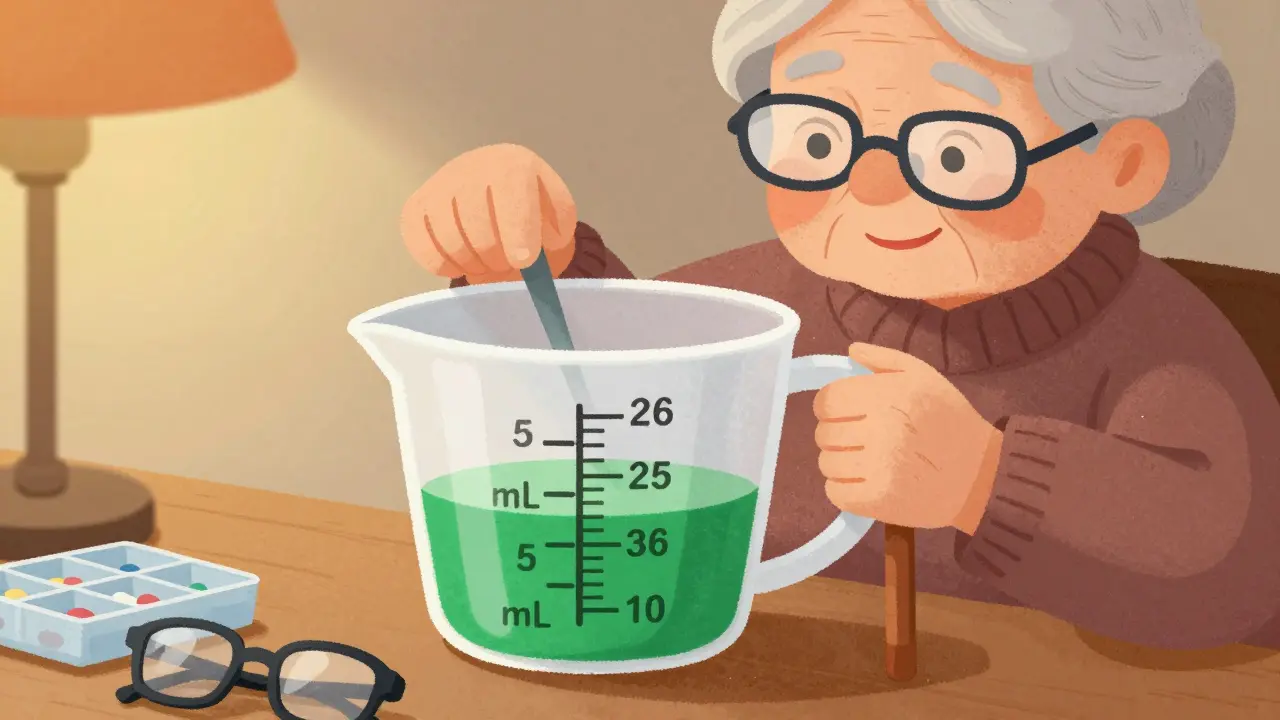
Measuring Cups and Oral Dosing Tools
Measuring cups for medicine used to look like kitchen measuring spoons - small, confusing, easy to spill. Modern visual dosing cups are different.
- They’re wide and shallow so you can see the liquid clearly.
- They have large, raised numbers that you can feel with your fingers.
- They include dual-unit markings - mL and teaspoons - but with clear separation so you don’t mix them up.
- Some have a spout with a drip-stop to prevent spills when pouring.
One key innovation? Color-coded zones again. A cup might have a green band from 5 mL to 10 mL - the safe range for most children. Anything above 10 mL? Red. No calculation needed. Just fill to the green line.
These tools are especially useful in homes, schools, and nursing homes where caregivers aren’t medical professionals. The goal isn’t to train them. It’s to make the tool do the thinking.
What Works Best? The Evidence
The data doesn’t lie. In a controlled simulation of emergency epinephrine administration:
| Measure | With Visual Aid | Without Visual Aid |
|---|---|---|
| Error Rate | 18.2% | 40% |
| Average Time to Administer | 97 seconds | 152 seconds |
| Participant Confidence | 97.8% agreed it helped | N/A |
| Time Saved | 36.2% faster | - |
That’s not just a small improvement. It’s life-saving. In an emergency, seconds matter. Getting epinephrine into a patient’s muscle 55 seconds faster? That’s the difference between recovery and cardiac arrest.
Even more telling? The error rate didn’t drop to zero. That’s important. Visual aids don’t fix everything. The most common error? Self-administering the shot incorrectly - even with the aid. That means training still matters. So does clear labeling. Visual tools are part of a system, not a magic fix.
Who Benefits Most?
These tools aren’t just for hospitals. They’re for:
- Parents giving liquid medicine to toddlers - no more guessing with kitchen spoons.
- Seniors managing multiple prescriptions - especially those with arthritis or vision loss.
- Teachers and school nurses handling asthma inhalers or seizure meds.
- Home caregivers for dementia patients who can’t read labels.
- Paramedics and ER staff under pressure - where every second counts.
These tools work best when they’re easy to find and always available. A syringe that’s tucked away in a drawer doesn’t help. A dropper that’s stuck in a pharmacy bag doesn’t help. They need to be part of the routine - like a thermometer or a blood pressure cuff.

Limitations and What to Watch For
Visual dosing aids are powerful - but they’re not perfect.
- Training still matters. If someone doesn’t know how to read the color zones, they might ignore them.
- Compatibility matters. Not all syringes fit all medicine bottles. Make sure the tool matches the medication.
- They’re not for all meds. Solid pills don’t need them. But liquids, injections, and eye drops? Absolutely.
- They can break. A cracked dropper or faded syringe can be dangerous. Replace them if the markings are worn.
Also, don’t assume one size fits all. A syringe designed for a 10kg child won’t work for a 30kg teen. Always match the tool to the patient’s weight or dose range.
How to Choose the Right Tool
If you’re buying one for home use, here’s what to look for:
- Clarity over detail. Fewer lines = fewer mistakes. Avoid syringes with 20+ markings.
- Color coding. Green for safe, red for danger - it’s universal.
- Easy grip. Should fit comfortably in small hands or arthritic fingers.
- Clear labeling. Should say "for oral use only" or "not for injection" - no guesswork.
- Compatibility. Does it fit your medicine bottle? Test it before buying.
Look for tools labeled "FDA-cleared" or "ISMP-recommended." The Institute for Safe Medication Practices has a list of approved dosing tools. You won’t find them on every pharmacy shelf - but you can order them online or ask your pharmacist.
What’s Next?
These tools are getting smarter. Some now have QR codes that link to video instructions. Others connect to apps that track doses. But the core idea stays the same: make the medicine visible. Make it simple. Make it safe.
Visual dosing aids aren’t about technology. They’re about humanity. They’re about giving a tired parent peace of mind. Giving an elderly person independence. Giving a nurse a second to breathe during a crisis.
It’s not magic. It’s just good design.
Can I use a kitchen spoon to measure medicine?
No. Kitchen spoons vary in size and aren’t calibrated. A teaspoon from your kitchen might hold anywhere from 3 mL to 7 mL. That’s a dangerous range for medicine. Always use a dosing syringe, dropper, or cup designed for medication. They’re accurate to within 0.1 mL.
Are visual dosing aids only for kids?
No. While they’re especially helpful for children, they’re just as important for older adults, people with vision problems, or anyone managing multiple medications. Elderly patients are at high risk for dosing errors - and visual aids reduce that risk significantly.
Do pharmacies provide visual dosing tools?
Some do, but not all. Many still hand out standard syringes or cups. Ask for a "visual dosing syringe" or "color-coded dropper" when picking up liquid medicine. Most pharmacies will give you one at no extra cost if you request it.
Can I reuse a visual dosing syringe?
Yes - if it’s designed for reuse. Most oral syringes are made of medical-grade plastic and can be washed with soap and water. Let them air dry. Don’t boil them or put them in the dishwasher unless the package says it’s safe. Replace them if the markings fade or the plunger gets stiff.
Why do some visual aids still have errors?
Because tools don’t fix human behavior. Even with a perfect visual aid, someone might misread it, rush, or assume they know the dose. Training, clear instructions, and double-checking are still essential. Visual aids reduce errors - they don’t eliminate them.









Skilken Awe
14 Feb 2026 at 10:46Oh wow, another 'design solves everything' fairy tale. Let me guess - you're also selling these 'visual dosing syringes' on Etsy? Because nothing says 'public health innovation' like a color-coded plastic tube that somehow magically prevents a parent from being drunk, distracted, or just plain stupid. The 18.2% error rate? That's not a win. That's a failure dressed in neon green. And don't get me started on the 'color zones.' What if you're colorblind? Oh wait - you didn't mention that. Typical.