



Ever taken a fiber supplement and then wondered if your blood pressure pill or thyroid medicine is still working? You're not alone. Millions of people take fiber supplements like psyllium (Metamucil), methylcellulose (Citrucel), or inulin to help with digestion, but many don’t realize these supplements can quietly interfere with how well their medications work. The problem isn’t that fiber is bad-it’s actually great for your heart, gut, and blood sugar. But when you mix it with pills at the wrong time, your body might not absorb enough of the drug. That can mean your medication doesn’t do what it’s supposed to. The good news? It’s easy to fix. You just need to know when to take what.
How Fiber Interferes With Medications
Fiber doesn’t get digested. Instead, it moves through your gut like a sponge, soaking up water and sweeping things along. When you take a fiber supplement at the same time as a pill, that sponge can grab onto the drug molecules and carry them out of your body before they have a chance to be absorbed. This isn’t just theory-it’s been shown in studies. For example, a 1993 study found that people taking levothyroxine (a thyroid hormone) with ispaghula husk (a type of psyllium) absorbed less of the drug. Some patients saw their LDL cholesterol go up because their thyroid medication wasn’t working well enough.
Not all fibers act the same. Soluble fibers like psyllium, oat bran, and pectin are more likely to bind to drugs because they form a gel. Insoluble fibers like cellulose seem to cause fewer problems. But even then, the dose matters. Eating an apple or a bowl of oatmeal won’t usually interfere with your meds. But a tablespoon of powdered fiber supplement? That’s a concentrated hit of fiber that can disrupt absorption.
Another issue is speed. Fiber speeds up how fast things move through your intestines. If your pill doesn’t have enough time to dissolve and get absorbed, it passes right through. This is especially risky for drugs that need to be absorbed slowly and steadily-like lithium, carbamazepine, or metformin.
Medications That Definitely Need Space From Fiber
Some drugs are more sensitive than others. Here are the ones you need to be most careful with:
- Levothyroxine (Synthroid, Levoxyl): This thyroid hormone has a narrow window for effectiveness. Even a small drop in absorption can throw your thyroid levels out of balance. Studies show fiber can reduce its uptake by up to 25% in some cases.
- Metformin: Used for type 2 diabetes, metformin needs consistent absorption to control blood sugar. Fiber supplements can lower its effectiveness, leading to higher glucose levels.
- Lithium: Used for bipolar disorder, lithium has a very small difference between a therapeutic dose and a toxic one. Fiber can alter how much enters your bloodstream, risking either reduced effect or dangerous buildup.
- Olanzapine (Zyprexa): This antipsychotic can be less effective if fiber binds to it in the gut.
- Carbamazepine (Tegretol): An epilepsy and nerve pain medication that’s also affected by fiber’s binding effect.
For these, the advice isn’t vague-it’s specific. Take your fiber supplement at least 2 hours before or after taking these medications. Some experts, like those at FreeRX, recommend waiting 4 hours after taking olanzapine or metformin for extra safety.
What About Other Drugs?
Not every medication is affected. Studies show that fiber supplements don’t seem to interfere with drugs like rosuvastatin (Crestor), clopidogrel (Plavix), or even calcium supplements in postmenopausal women. The NIH found no significant drop in calcium absorption when psyllium was taken together.
Why the difference? It comes down to how the drug is absorbed. Some drugs are absorbed quickly in the upper gut-so they’re done before fiber even gets there. Others are absorbed slowly and over a longer stretch of intestine, where fiber is already swirling around. If your drug is one of the latter, fiber can mess with it. If it’s the former, you’re probably fine.
Bottom line: Don’t assume. If you’re on any prescription, check with your pharmacist or doctor. Especially if you’ve noticed changes in how you feel since starting fiber.
The Right Way to Time It
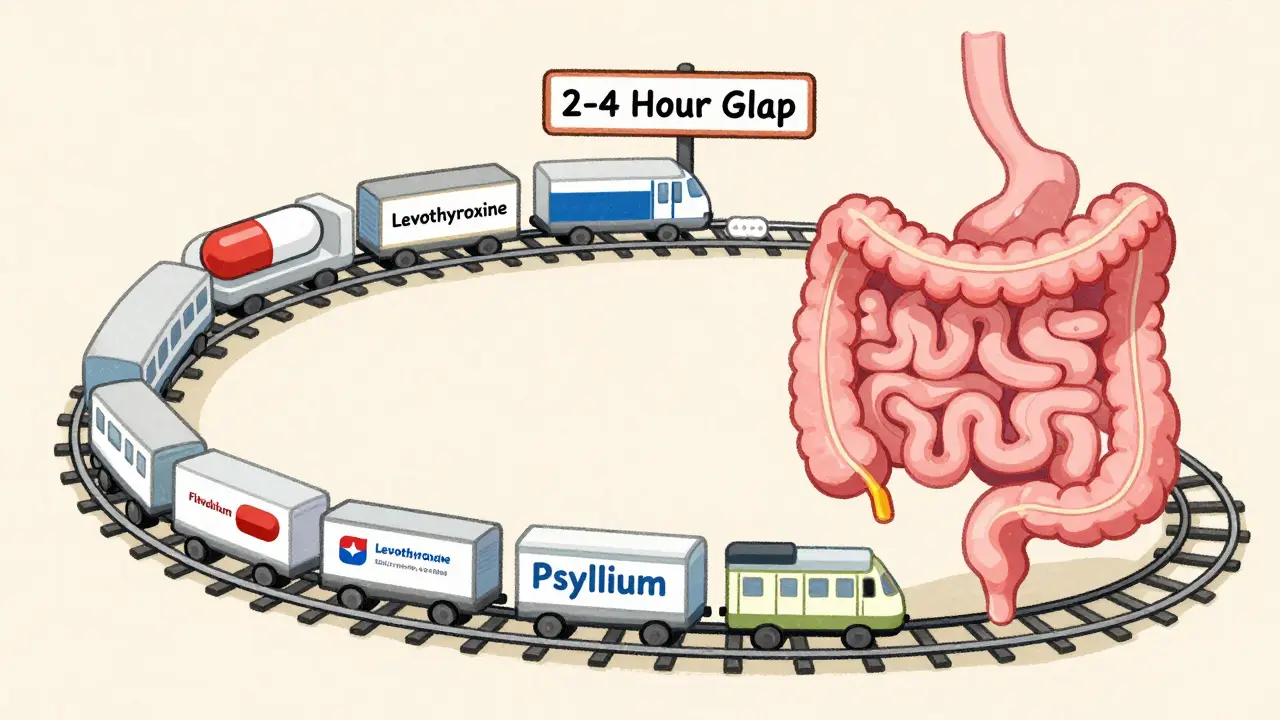
The consensus across Harvard Health, Mayo Clinic, and WebMD is clear: separate fiber and meds by 2 to 4 hours. Here’s how to make it work in real life:
- Morning routine: Take your thyroid med or other critical drug first thing, on an empty stomach, with a full glass of water. Wait 2 hours before taking your fiber supplement. Many people find it easiest to take fiber at lunch or dinner.
- Evening meds: If you take your pill at night, don’t take fiber right before bed. It can cause bloating, gas, or cramping that keeps you awake. Take fiber at least 4 hours before bed, or better yet, earlier in the day.
- Consistency matters: Pick a time and stick to it. If you take fiber at 7 a.m. one day and 9 p.m. the next, your body won’t adjust. Same goes for your meds.
- Hydrate: Always take fiber with at least 8 ounces of water. Fiber swells in your throat if you don’t drink enough-and that’s dangerous.
Think of it like this: your fiber supplement is a train. Your medication is a passenger. If they’re on the same train, the passenger might get dropped off too early. But if they take different trains-spaced out by a few hours-they both get where they need to go.
Fiber From Food vs. Supplements
Here’s something important: eating fiber-rich foods like apples, beans, oats, or broccoli rarely causes problems. Why? Because the fiber is spread out, mixed with other nutrients, and not concentrated. A slice of whole-grain bread won’t interfere with your meds the way a scoop of Metamucil might.
That’s why experts say: get your fiber from food when you can. The American Heart Association recommends 25-30 grams of fiber daily. Most people get only about half that. Supplements can help fill the gap-but they shouldn’t replace whole foods. If you’re relying on fiber pills because you don’t eat enough vegetables, that’s a sign to rethink your diet, not just your timing.

What Happens If You Don’t Separate Them?
Sometimes, nothing. You might not notice. But for some people, the effects are serious.
Take levothyroxine. If you take it with psyllium every morning, your TSH levels might creep up over time. Your doctor might think your hypothyroidism is getting worse-and increase your dose. But if you stop taking fiber with it, your levels might drop back down. You could end up on too high a dose for no reason.
Same with metformin. If you’re taking it with fiber and your blood sugar starts climbing, you might think you need more meds. But it’s not the drug failing-it’s the fiber blocking it.
These aren’t hypothetical risks. They’re documented in medical journals. And they’re avoidable.
What to Do If You’re Already Taking Them Together
If you’ve been taking your fiber and meds at the same time for months or years, don’t panic. But do take action.
- Check your medication list. Look for the drugs mentioned above.
- Call your pharmacist. Pharmacists see these interactions every day. They can flag which of your meds are at risk.
- Ask your doctor for a blood test. If you’re on levothyroxine, lithium, or metformin, a simple lab check can tell you if your levels are where they should be.
- Start separating them. Even if you’ve been fine, it’s better to be safe.
There’s no need to quit fiber. You just need to adjust your schedule. And once you do, you’ll get the benefits of fiber without risking your meds.
Final Tip: Make It Routine
Here’s a simple system that works for thousands:
- 6 a.m. Take thyroid med, diabetes med, or other critical drug with water.
- 8 a.m. Eat breakfast (with natural fiber from fruit, oats, etc.).
- 1 p.m. Take fiber supplement with a full glass of water.
- 8 p.m. Take any other meds (if not already taken).
This keeps fiber and sensitive drugs at least 4 hours apart. And it’s easy to remember. No guesswork. No confusion. Just a rhythm that keeps you healthy on all fronts.
Can I take fiber supplements with my multivitamin?
It depends. Most multivitamins are fine with fiber, but if your multivitamin contains iron, calcium, or thyroid-supporting nutrients like iodine, it’s best to separate them by 2 hours. Fiber can bind to minerals and reduce their absorption. If you’re unsure, take your multivitamin with breakfast and your fiber supplement at lunch.
Does it matter if the fiber supplement is soluble or insoluble?
Yes. Soluble fibers-like psyllium, inulin, and oat bran-form gels that are more likely to bind to medications. Insoluble fibers like cellulose or wheat bran are less likely to interfere. But because most fiber supplements are soluble (and more potent), it’s safest to assume all of them need separation from meds.
I take fiber at night. Is that okay?
Only if you don’t take any meds within 4 hours of it. Many people take fiber at night to help with constipation, but if you take your meds before bed, you’re risking interference. Switching fiber to the morning or afternoon is better. And always drink plenty of water-fiber at night without enough fluid can cause bloating or cramps that disrupt sleep.
Can I take fiber with my blood pressure pills?
Most blood pressure medications are fine with fiber. Drugs like lisinopril, amlodipine, or hydrochlorothiazide aren’t known to interact with fiber supplements. But if you’re on multiple meds-including one for thyroid, diabetes, or mental health-check with your pharmacist. It’s the combination that matters, not just one drug.
Should I stop taking fiber supplements altogether?
No. Fiber is one of the most important nutrients for long-term health. It lowers your risk of heart disease, stroke, and type 2 diabetes. The goal isn’t to quit fiber-it’s to take it at the right time. If you’re taking it with meds, you’re probably not getting the full benefit of either. Separating them fixes both problems.





Betty Kirby
16 Feb 2026 at 05:34Fiber supplements are not a cure-all. They're a band-aid for a diet that's been systematically dismantled by processed foods and corporate nutrition. If you're relying on Metamucil to fix your digestion, you're ignoring the root problem: you're not eating real food. Whole foods deliver fiber, phytonutrients, and microbiome support in a package that doesn't require a 2-hour buffer zone with your prescriptions. Stop treating symptoms and start fixing the system.