



When you have asthma, knowing whether your airways are inflamed isn’t just helpful-it can change your treatment, prevent hospital visits, and even save your life. That’s where FeNO testing comes in. It’s not a lung function test like spirometry. It’s not a blood draw. It’s something simpler: you breathe into a device, and it measures how much nitric oxide is in your breath. That number tells your doctor whether your airways are swollen from inflammation-and whether your inhaler is working.
What Exactly Is FeNO Testing?
FeNO stands for Fractional Exhaled Nitric Oxide. It’s a way to measure a gas called nitric oxide that your body naturally produces in the lining of your airways when there’s inflammation. In asthma, especially the type driven by allergies or eosinophils (a kind of white blood cell), this gas builds up. High levels mean your airways are inflamed. Low levels mean they’re not-or at least, not in that way.
The test is quick, painless, and works for kids as young as five. You take a deep breath through a filter that blocks outside air, then exhale slowly and steadily into a handheld device for about 10 seconds. No needles. No fasting. No special prep beyond avoiding food, smoke, or intense exercise for an hour before. The device gives you a number in parts per billion (ppb). That’s it.
What Do the Numbers Mean?
FeNO levels vary by age and health. For adults, a reading of 25 ppb or higher suggests significant airway inflammation linked to asthma. For children between 5 and 12, the cutoff is 20 ppb. These aren’t random numbers-they’re based on years of research and guidelines from the American Thoracic Society and GINA (Global Initiative for Asthma).
The results are usually broken into three zones:
- Low (under 25 ppb in adults): Unlikely that eosinophilic inflammation is driving your asthma. Steroid inhalers may not help much.
- Medium (25-50 ppb): Some inflammation present. Your asthma might respond well to inhaled steroids.
- High (over 50 ppb): Strong evidence of type 2 inflammation. You’re likely a good candidate for steroid treatment-or even biologic drugs like dupilumab.
These numbers aren’t just labels. They guide real decisions. A 2022 study showed that using FeNO to adjust treatment cut asthma flare-ups by up to 50%. That’s not small. That’s life-changing.
Why FeNO Over Other Tests?
Most people think asthma is diagnosed with spirometry-blowing hard into a machine to measure airflow. But spirometry only tells you if your airways are narrowed right now. It doesn’t tell you why. Two people can have the same lung function numbers, but one has inflamed airways and the other doesn’t. That’s where FeNO steps in.
Compared to blood tests for eosinophils, FeNO is faster, cheaper, and more directly tied to the airways. Sputum tests-where you cough up mucus to check for eosinophils-are accurate but messy and hard to do. FeNO? You do it in the doctor’s office in under a minute.
But here’s the catch: FeNO doesn’t catch every kind of asthma. If your asthma is triggered by cold air, stress, or infection-rather than allergies-your FeNO might be normal even if you’re struggling. That’s why it’s never used alone. It’s a piece of the puzzle, not the whole picture.
How It Changes Treatment
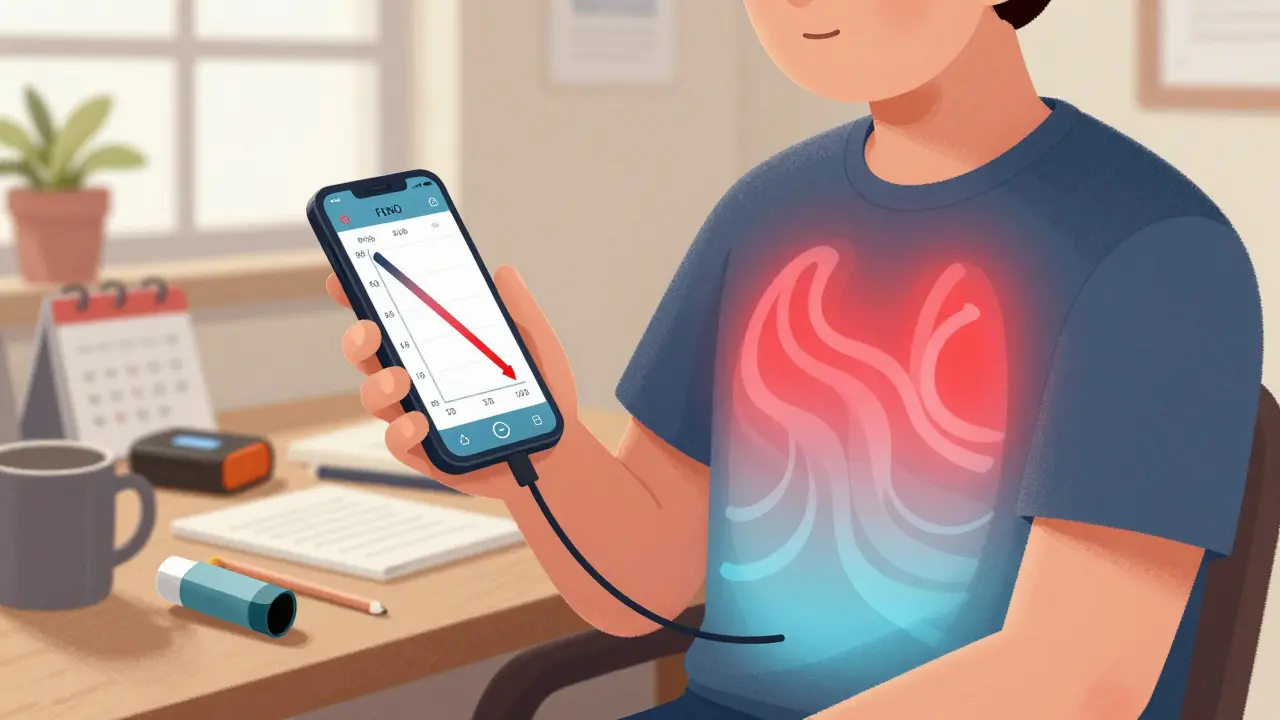
Imagine this: You’ve been on a steroid inhaler for months, but you’re still wheezing. Your doctor isn’t sure if you’re not using it right, if it’s not strong enough, or if you have a different kind of asthma. FeNO gives an answer. If your level is still high, the drug isn’t working. Time to switch or add something stronger. If it’s dropped into the low range? You’re doing great.
Patients report real relief from this. One user on Reddit said, “Finally, objective proof my inhaler wasn’t working.” Another told their allergist, “My FeNO went from 68 to 18 after the new biologic. I haven’t used my rescue inhaler in three months.”
FeNO also helps avoid overtreating. If your levels are low and you’re still on high-dose steroids, you might be at risk for side effects like weight gain, bone thinning, or oral thrush. Dropping the dose could make your life better without risking control.
Limitations and Misconceptions
FeNO isn’t perfect. Smoking cuts FeNO levels by 30-50%, so if you smoke, the test might look normal even if you’re inflamed. Allergic rhinitis can raise FeNO, too-so if you have a runny nose, that might show up on the test. Recent steroid use, even oral, can lower it, making results misleading.
And here’s the biggest myth: FeNO can’t rule out asthma. A low number doesn’t mean you don’t have it. It just means your asthma isn’t driven by type 2 inflammation. That’s why the American Thoracic Society says it should never be used alone. It’s a tool to confirm, not exclude.
Dr. Sally Wenzel from the University of Pittsburgh puts it bluntly: “FeNO has lower sensitivity. It’s not good for ruling out asthma.” That’s why doctors combine it with symptoms, lung function, and sometimes blood tests. Together, they paint a clearer picture.
Who Gets Tested and How Often?
FeNO testing is most useful for:
- People with unclear asthma diagnosis
- Those who don’t respond to standard inhalers
- Patients considering biologic therapies
- Those with frequent flare-ups despite treatment
For people already on maintenance therapy, testing every 3-4 months helps track progress. After a flare-up or a treatment change, it’s often done within 4-6 weeks to see if things are moving in the right direction.
Training for providers is minimal. Most clinics can start using it after a 20-minute demo. Devices like the NIOX VERO® and NObreath® have built-in feedback that guides breathing, cutting invalid tests from 20% down to under 5%.
Access and Cost Issues
Despite its value, FeNO testing isn’t everywhere. In the UK, NICE guidelines require it to be available in all asthma clinics. In the US, adoption is patchy. About 68% of pulmonologists and 52% of allergists use it regularly, but only 41% of community clinics do.
Why? Insurance. Medicare covers it under code 95012, but many private insurers don’t-or they require prior authorization. One patient reported being denied coverage three times before getting approved. Rural areas are even worse: only 22% of clinics there offer FeNO, compared to 67% in cities.
Costs vary. The test itself might run $50-$150 out-of-pocket. But when you factor in ER visits, missed work, or hospital stays from uncontrolled asthma, it’s a bargain. A CDC report says asthma costs the U.S. $56 billion a year. FeNO could save billions by preventing those flare-ups.
What’s Next for FeNO?
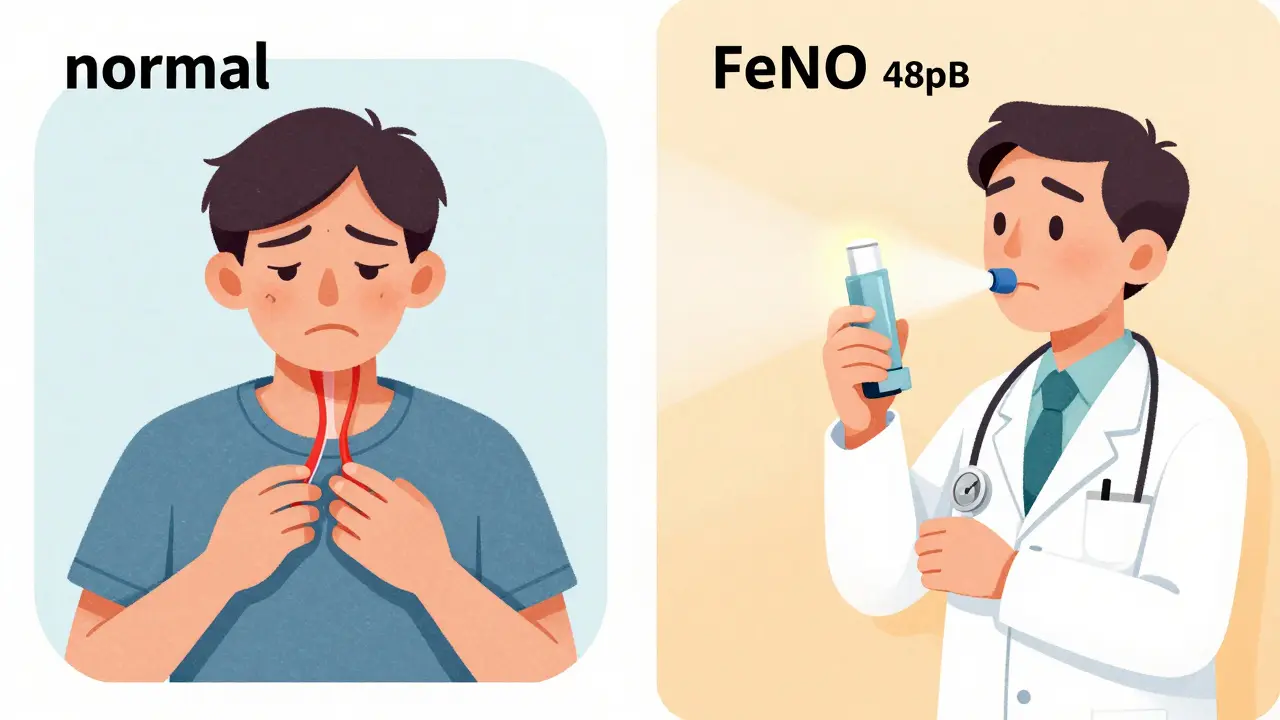
The future is getting personal. In early 2023, the FDA cleared the first smartphone-connected FeNO device-Breathometer Asthma-for home use. It costs $299 and syncs with an app to track trends over time. For patients on biologics, this could mean fewer clinic visits and more control.
Researchers are also testing whether FeNO can predict who will respond to expensive biologic drugs like benralizumab. Early data suggests yes. If it works, FeNO could become a gatekeeper-ensuring these powerful drugs go only to those who truly need them.
Studies like the NIH-funded PREPARE-Asthma trial are now looking at how to standardize FeNO across devices and populations. Right now, different machines give slightly different numbers. That’s a problem if you switch clinics or move cities.
Real Stories Behind the Numbers
A 34-year-old woman in Ohio spent seven years being treated for chronic bronchitis. She coughed. She wheezed. She used her rescue inhaler daily. Her spirometry was always “normal.” Then she got a FeNO test. Result: 48 ppb. Her doctor switched her diagnosis to asthma, started her on an inhaled steroid, and within weeks, her symptoms vanished. She hadn’t realized she was being misdiagnosed-until a simple breath test changed everything.
Another patient, a 10-year-old boy in Texas, couldn’t play sports. His parents thought he was just out of shape. FeNO showed 32 ppb. He was put on a low-dose steroid inhaler. Within a month, he was back on the soccer field. His parents didn’t know what FeNO was before-but now, they check his levels every few months.
These aren’t rare cases. They’re the new normal for asthma care.
Final Thoughts
FeNO testing isn’t magic. But it’s one of the clearest, most objective tools we have to understand what’s really going on inside your airways. It doesn’t replace your doctor. It doesn’t replace your symptoms. But it gives your doctor hard data to back up gut feelings.
If you have asthma and your treatment isn’t working, ask: Has my FeNO been checked? If not, why not? It’s simple. It’s quick. And for many people, it’s the missing piece they’ve been searching for.
What does a high FeNO level mean for asthma?
A high FeNO level (over 25 ppb in adults, over 20 ppb in children) strongly suggests the presence of type 2 airway inflammation, which is often driven by allergies or eosinophils. This type of inflammation typically responds well to inhaled corticosteroids and biologic therapies. High levels also correlate with increased risk of future asthma exacerbations.
Can FeNO testing diagnose asthma on its own?
No. FeNO testing cannot diagnose asthma by itself. While it’s excellent at confirming eosinophilic inflammation, it has low sensitivity-meaning many people with asthma, especially non-allergic or non-type 2 asthma, will have normal FeNO levels. Diagnosis must always include clinical symptoms, lung function tests like spirometry, and sometimes other biomarkers.
How often should FeNO be tested?
For patients on maintenance asthma therapy, FeNO testing is typically done every 3 to 4 months to monitor inflammation levels. More frequent testing-every 4 to 6 weeks-is recommended after starting or changing medications, especially biologics or high-dose steroids, to assess treatment response.
What factors can affect FeNO test results?
Several factors can alter FeNO readings: smoking reduces levels by 30-50%, recent use of inhaled or oral steroids lowers them, and allergic rhinitis or viral infections can raise them. Eating, drinking (except water), smoking, or vigorous exercise within one hour before the test can also lead to inaccurate results. Proper preparation is key.
Is FeNO testing covered by insurance?
Medicare covers FeNO testing under CPT code 95012 when used for asthma management. However, many private insurers require prior authorization or deny coverage outright. Coverage varies widely by plan and region. In the UK, NICE guidelines mandate availability, but in the U.S., only about 58% of commercial plans cover it without restrictions.




Patrick Jackson
7 Mar 2026 at 15:33FeNO testing is like having a secret decoder ring for your lungs 😍 I had no idea my chronic cough was just uncontrolled inflammation. My doctor ordered it after years of failed treatments, and boom-my FeNO was 52. Switched to a biologic, and now I can run without wheezing. Life-changing. Why isn’t this standard everywhere?