



When a doctor hands you a prescription, they’re not just giving you pills-they’re giving you a plan. But too often, that plan gets lost in translation. You leave the office with a bottle in hand, but no real sense of what the medication is for, when it’ll start working, or what side effects might mean trouble. This isn’t just confusing-it’s dangerous. Half of all people with chronic conditions don’t take their meds as prescribed, and poor communication is one of the biggest reasons why.
Why Clear Medication Communication Matters
Medication misunderstandings cost the U.S. healthcare system about $300 billion every year. That’s not just money-it’s hospital visits, emergency trips, and avoidable complications. The problem isn’t that patients are careless. It’s that providers often assume patients understand more than they do. A 2017 JAMA study found people remember less than half of what’s said during a doctor’s visit. And with the average appointment lasting just 15.7 minutes, there’s little room for error-or clarification. The solution isn’t more time. It’s better communication. When patients clearly understand why they’re taking a medication, when to expect results, and what side effects are normal, they’re far more likely to stick with the treatment. Studies show that when providers use simple, direct language and verify understanding, medication adherence jumps by 20% or more.What Patients Need to Know
There are five core pieces of information every patient needs about a new medication:- Why you’re taking it-Not just the medical term, but what it actually does in your body. Instead of saying, “This is an ACE inhibitor,” say, “This lowers your blood pressure by relaxing your blood vessels.”
- When you’ll feel the effect-Many patients stop taking meds because they don’t see immediate results. Clarify: “Most people notice less joint pain in 2 to 3 weeks,” or “This might take 6 weeks to fully help your cholesterol.”
- How and when to take it-Avoid vague phrases like “take as directed.” Say, “Take one pill with breakfast and one with dinner.” Mention if it should be taken with food, on an empty stomach, or at bedtime.
- What side effects are normal-Don’t just list every possible side effect. Say, “Some people feel a little dizzy the first week-that’s common and usually goes away. But if you feel faint or your heart races, call us right away.”
- What to do if you miss a dose-Give a clear rule: “If you forget in the morning, take it when you remember. If it’s already evening, skip it and take your next dose at the regular time.”
The Teach-Back Method: Your Most Powerful Tool
The single most effective technique for ensuring understanding is called Teach-Back. It’s simple: after explaining something, ask the patient to explain it back to you in their own words. Instead of asking, “Do you understand?”-which almost always gets a polite “yes”-say:- “To make sure I explained this clearly, can you tell me how you’ll take this pill each day?”
- “What would you say to your spouse about why you’re taking this?”
- “If you felt dizzy after taking this, what would you do?”
Use Plain Language-No Jargon Allowed
Medical terms like “BID,” “PO,” or “hypertension” have no place in patient conversations. Eighty million American adults have trouble understanding basic health information. That’s not their fault-it’s ours. Replace:- “Take this PO BID” → “Take one pill by mouth twice a day”
- “This is a statin” → “This lowers your bad cholesterol”
- “You may experience GI upset” → “This might give you a stomachache or nausea”
Quantify Benefits and Risks
Don’t say, “This reduces your risk of heart attack by 30%.” That sounds impressive-but it’s misleading. A 30% relative reduction means nothing if you don’t know the starting point. Instead, say:- “Out of 100 people like you, 10 will have a heart attack in 10 years without this medicine. With it, that number drops to 8.”
- “About 1 in 10 people taking this may feel a bit dizzy at first. Most stop feeling it after a few days.”
Visuals and Tools Make It Stick
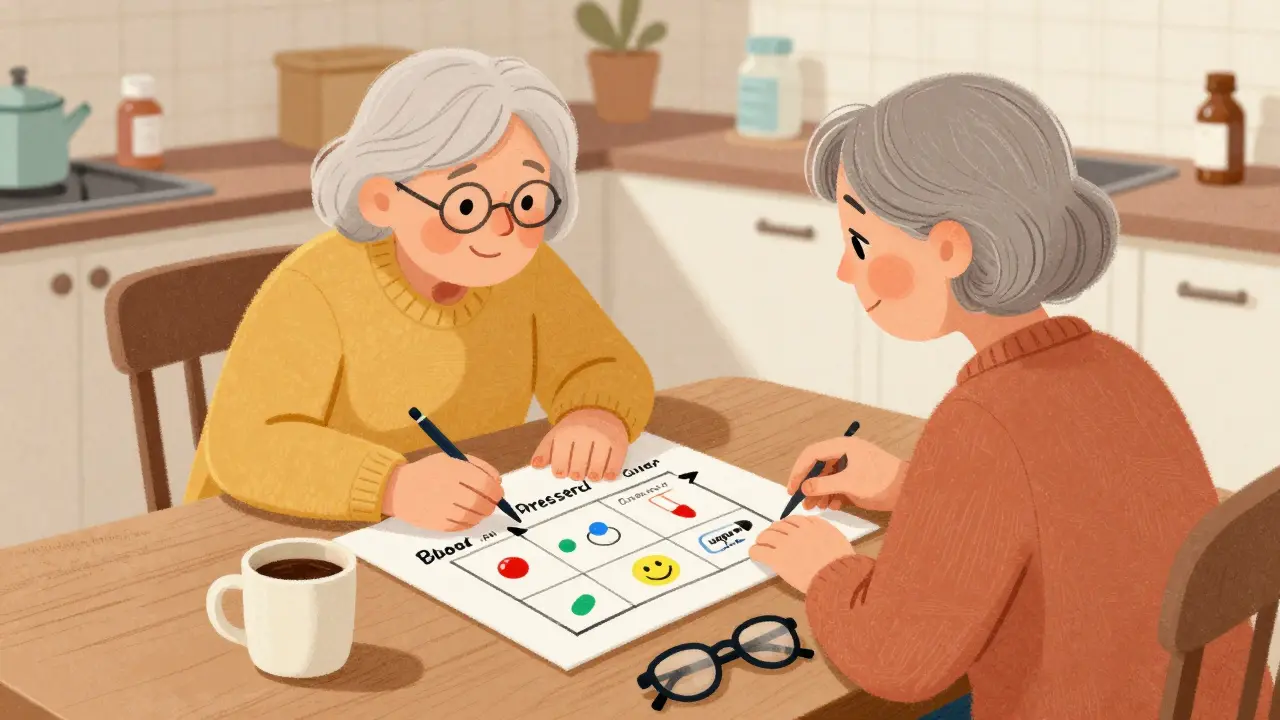
A picture is worth a thousand words-especially when it comes to pills. Use a pill organizer to show exactly how many pills to take and when. Draw a simple timeline: “Day 1-7: You might feel tired. Day 8-14: You’ll start feeling more energy. Day 15+: You should feel your usual self.” Some clinics now use printed cards with icons: a clock for timing, a stomach for side effects, a phone for when to call. These aren’t fancy-they’re functional. Patients who get these tools are 40% more likely to remember their instructions.Don’t Rush the Conversation
Even if your schedule is packed, don’t skip the check-in. A 2022 AHRQ survey found that 63% of patients felt they couldn’t ask questions when their provider was even slightly behind schedule. Slow down. Speak at 130-150 words per minute-about 20% slower than normal conversation. Pause after each key point. Give space for questions. If you’re pressed for time, schedule a 10-minute follow-up just for medication questions. Clinics that do this see a 37% improvement in patient understanding.Use Team-Based Support
You don’t have to do it all alone. Pharmacists are trained to explain medications in detail. In fact, when pharmacists lead medication reviews for patients on five or more drugs, hospital admissions drop by 22%. Work with your pharmacy team. Have them call patients after a new prescription to confirm timing, side effects, and questions. Many health systems now use automated text reminders that reference your conversation: “Remember, we talked about dizziness being normal the first week. Take this with food if it happens.”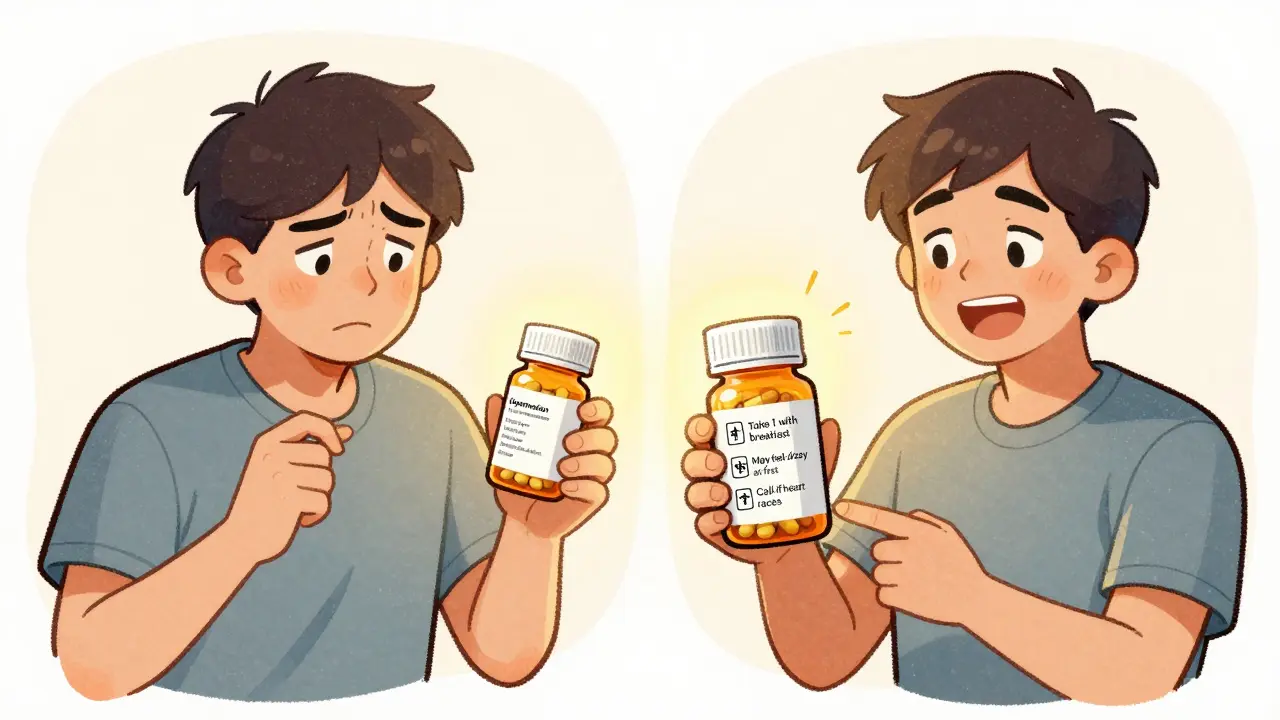
Document What Was Said
The Joint Commission now requires providers to document the patient’s understanding of their medication’s purpose, schedule, and expected effects. This isn’t just paperwork-it’s protection. If a patient has a bad reaction and says they weren’t warned, your notes can show you did your part. Use your EHR’s built-in templates. Many now include prompts like:- Patient stated reason for taking medication: ______
- Teach-back performed: Yes/No
- Key side effects discussed: ______
What Not to Do
Avoid these common mistakes:- Don’t say “Take as directed.” Always specify timing and instructions.
- Don’t use medical terms like “hypertension,” “hyperlipidemia,” or “BID.”
- Don’t assume the patient remembers what was said last visit. Review every time.
- Don’t ignore emotional reactions. If a patient says, “I’m scared this will make me sick,” respond with: “That’s a real concern. Many patients feel that way. Let’s talk about what’s most likely to happen.”
Real Stories, Real Results
One patient told her doctor she stopped her blood pressure pill because she didn’t feel any different. The doctor asked her to explain what it was for. She said, “I think it’s for my heart.” He corrected her gently: “It’s to protect your kidneys and prevent stroke. Even if you feel fine, it’s still working.” She started taking it again-and stayed on it. Another patient, 72, was on six medications. Her pharmacist sat down with her, drew a chart of each pill with its purpose, and asked her to explain them back. She got three wrong. They fixed it on the spot. Three months later, she hadn’t been to the ER. These aren’t miracles. They’re just good communication.What’s Next?
Technology is helping. AI tools are being tested to listen to doctor-patient conversations and flag missed Teach-Back moments. EHRs now have built-in prompts to guide providers through key points. But the heart of it hasn’t changed: it’s about listening, speaking clearly, and making sure the patient walks out knowing exactly what to do. Start small. Pick one medication you prescribe often. Practice Teach-Back with every patient for a week. See what changes. You’ll notice fewer calls to the office. Fewer missed doses. And more confident patients. Clear communication isn’t extra work. It’s the foundation of good care.Why do patients often forget what their doctor says about medications?
Patients forget because medical information is complex, delivered quickly, and often uses unfamiliar terms. Studies show people remember only about 49% of what’s said during a visit. Stress, distractions, and cognitive overload make it harder to retain details. That’s why simple language, repetition, and verification-like the Teach-Back method-are essential.
What is the Teach-Back method and how does it work?
Teach-Back is when a provider asks a patient to explain, in their own words, what they’ve been told about their medication. Instead of asking, “Do you understand?” the provider says, “Can you tell me how you’ll take this pill?” This reveals misunderstandings right away and gives the provider a chance to correct them. It’s not a test-it’s a tool to improve communication. Research shows it increases medication adherence by 23%.
Should I use medical terms like BID or PO when talking to patients?
No. Terms like BID (twice a day) or PO (by mouth) are confusing to most patients. Use plain language: “Take one pill in the morning and one at night,” or “Take this pill by mouth with water.” Eighty million American adults have limited health literacy, so avoiding jargon isn’t optional-it’s necessary for safety.
How can I explain medication benefits without misleading patients?
Use absolute numbers instead of percentages. Instead of saying “This reduces your risk by 30%,” say, “Out of 100 people like you, 10 will have a heart attack in 10 years without this medicine. With it, only 8 will.” This gives patients a clear, real-world picture of what to expect. Relative risk sounds bigger but can be misleading.
What should I do if a patient says they don’t feel the medication is working?
Don’t assume they’re noncompliant. Ask them to describe what they expected and when. Many medications take weeks to show effects. For example, antidepressants often need 4-6 weeks. Clarify the timeline: “It usually takes 2-3 weeks to notice less anxiety. If you don’t see any change after 6 weeks, we’ll talk about next steps.” This prevents early discontinuation.
Can pharmacists help with medication communication?
Yes. Pharmacists are trained to explain medications in detail and are often better equipped than doctors to answer complex questions about side effects, interactions, and timing. Many clinics now use pharmacists for medication reviews, especially for patients on five or more drugs. Studies show this reduces hospitalizations by 22%.
How can I fit clear medication communication into a short appointment?
Focus on the top 2-3 key points per visit. Speak slowly-130-150 words per minute. Use the Chunk and Check method: explain one small piece, then ask the patient to repeat it back. If you’re pressed for time, schedule a 10-minute follow-up just for medication questions. Many clinics see better results with this approach than trying to rush everything into one visit.
What if a patient doesn’t want to take their medication?
Don’t push. Ask why. Maybe they’re afraid of side effects, can’t afford it, or don’t believe it works. Listen first. Then say, “I hear you’re unsure. Let’s talk about what’s worrying you.” Offer alternatives if possible: a different pill, a lower dose, or a trial period. Sometimes just feeling heard makes patients more open to trying.





amanda s
18 Dec 2025 at 00:31This is why America's healthcare is a circus. Doctors act like they're doing you a favor by not killing you, then dump a prescription like it's a magic bullet. I had my cardiologist tell me to take 'this for your hypertension'-no explanation, no timeline, nothing. I Googled it myself because I didn't trust him to tell me the truth. Now I'm on three meds and still don't know if I'm supposed to feel better or just not die before 60. 🤡