


Macrolide Arrhythmia Risk Assessment
This tool helps identify potential risk factors for heart rhythm disturbances (QT prolongation) when prescribed macrolide antibiotics. It is based on clinical guidelines regarding patient history and demographics.

Why Check?
Macrolides can affect the electrical rhythm of the heart. Identifying risk factors helps you discuss safer options with your doctor.
Your Risk Assessment Result
Identified Risk Factors (0)
Recommendations
*Disclaimer: This tool is for educational purposes only and does not constitute medical advice. Always consult your healthcare provider before starting any medication.
Antibiotics save lives, but they aren't always harmless. When you pick up a prescription for macrolide antibiotics, which include common drugs like azithromycin and clarithromycin, you might not think about your heart. Yet, these medications carry a specific risk: they can disrupt the electrical rhythm of your heart, leading to a condition known as QT interval prolongation. This isn't just a minor side effect; in rare cases, it can trigger a dangerous arrhythmia called Torsades de pointes (TdP), which can be fatal if not treated immediately.
If you have been prescribed a macrolide, or if you are simply trying to understand why your doctor hesitated before writing that script, you need to know how this works. The risk is real, but it is also highly manageable. It depends less on the drug alone and more on your unique combination of health factors, other medications, and biology. Let’s break down exactly what happens inside your heart when you take these drugs, who is at risk, and how doctors are changing their practices to keep you safe.
How Macrolides Affect Your Heart Rhythm
To understand the risk, you first need to understand the heartbeat. Your heart beats because of electrical signals that tell the muscle cells to contract and then relax. This relaxation phase is called repolarization. On an electrocardiogram (ECG), the time it takes for this process to complete is measured as the QT interval.
Macrolides interfere with this process by blocking specific channels in your heart cells. Specifically, they bind to the human ether-a-go-go-related gene (hERG) potassium channels. These channels are responsible for letting potassium ions flow out of the cell, which helps reset the electrical charge. When macrolides block these channels, the potassium current slows down. The result? The heart takes longer to reset. On an ECG, this looks like a prolonged QT interval.
Why does a longer QT interval matter? If the heart takes too long to recharge, it can become electrically unstable. This instability can create early afterdepolarizations (EADs)-tiny, erratic electrical sparks that can trigger a chaotic, fast heartbeat known as Torsades de pointes. This type of ventricular tachycardia can cause fainting, seizures, or sudden cardiac death. However, this is not a common occurrence. It usually requires a "perfect storm" of risk factors to happen.
Risk Profiles: Not All Macrolides Are Equal
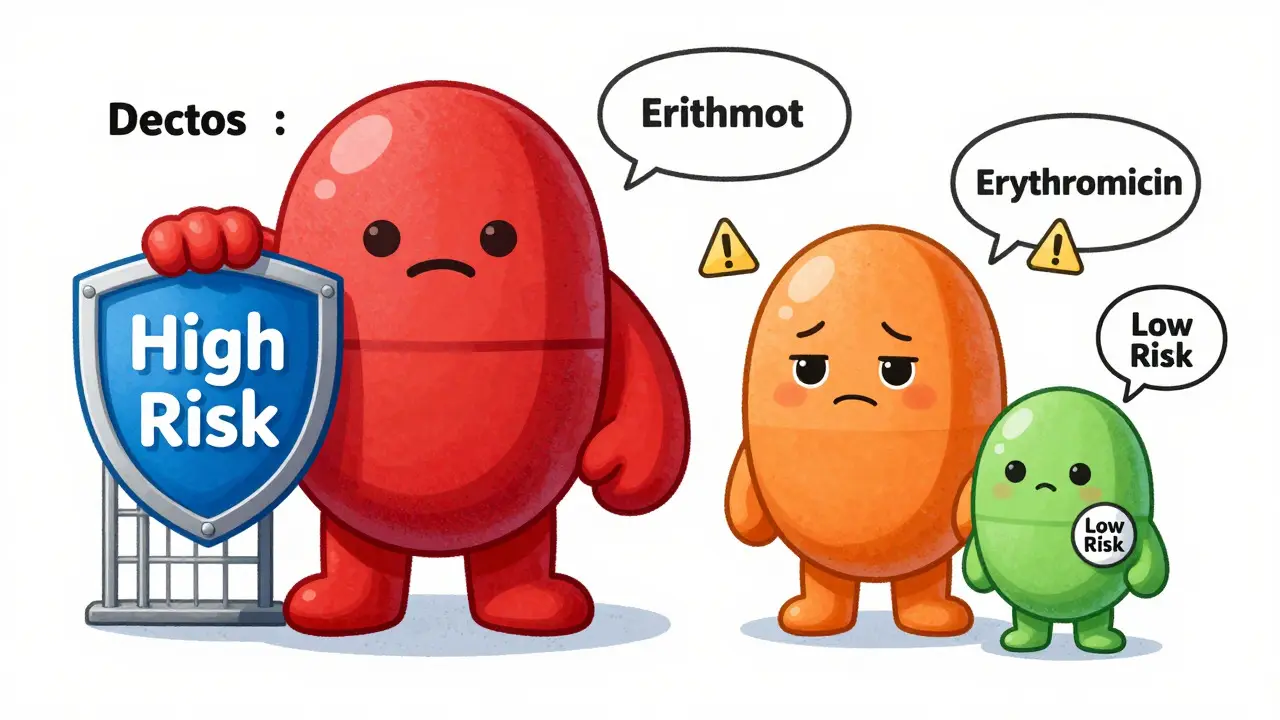
Not every macrolide carries the same level of danger. While they all belong to the same family, their chemical structures and how your body processes them differ significantly. Understanding these differences helps explain why some doctors prefer one over another.
| Drug | Ikr Blockade Potency | CYP3A4 Inhibition | Key Risk Factor |
|---|---|---|---|
| Clarithromycin | High | Strong (50-70%) | Dual mechanism: Direct channel blockade + increases levels of other QT-prolonging drugs |
| Erythromycin | Moderate | Moderate (20-30%) | Gastrointestinal issues can lead to hypokalemia (low potassium), worsening risk |
| Azithromycin | Low | Minimal (<10%) | Safest profile, but still carries risk in vulnerable patients or when combined with other drugs |
Clarithromycin is generally considered the highest risk. It blocks the potassium channels strongly and also inhibits the liver enzyme CYP3A4. This enzyme breaks down many other medications. When clarithromycin stops CYP3A4 from working, the levels of other drugs in your blood can rise dangerously high. If those other drugs also affect the heart, the risk multiplies.
Erythromycin is an older macrolide. While it doesn’t inhibit CYP3A4 as strongly as clarithromycin, it often causes stomach upset and diarrhea. This can lead to dehydration and low potassium levels (hypokalemia). Low potassium makes the heart even more sensitive to QT prolongation, creating a secondary pathway to arrhythmia.
Azithromycin has largely replaced the others in many clinical settings because it has minimal impact on CYP3A4 and weaker direct effects on the heart channels. However, "safer" does not mean "risk-free." Large-scale studies, including a 2012 analysis of Tennessee Medicaid data, showed that azithromycin still carries a small excess risk of cardiovascular death compared to non-macrolide antibiotics like amoxicillin, particularly during the first five days of treatment.
Who Is Most at Risk?
The absolute risk of developing Torsades de pointes from a macrolide is low-less than 1 case per 10,000 prescriptions in healthy people. But for certain groups, that number jumps significantly. Doctors look for specific "red flags" before prescribing these drugs.
- Female Sex: Women are disproportionately affected, accounting for about 68% of TdP cases associated with these drugs. Hormonal differences may play a role in how women metabolize these medications and how their hearts respond to electrical changes.
- Age Over 65: Older adults face a 2.4-fold increased risk. Aging hearts often have underlying structural changes, and older patients are more likely to take multiple medications that interact with macrolides.
- Existing Heart Conditions: Patients with heart failure, prior heart attacks, or structural heart disease have a 5.3-fold increased risk. Their hearts are already under stress, making them less resilient to electrical disturbances.
- Electrolyte Imbalances: Low potassium (hypokalemia) or low magnesium (hypomagnesemia) increases risk by 3.1-fold. These minerals are crucial for maintaining stable heart rhythms. Diuretics (water pills) commonly used for blood pressure can deplete these minerals.
- Polypharmacy: Taking other QT-prolonging drugs adds to the risk. Each additional medication that affects the QT interval increases the likelihood of an event by 1.8 times. Common culprits include certain antiarrhythmics, antipsychotics, and antidepressants.
- Baseline QTc >450 ms: If your resting heart rhythm already shows a prolonged QT interval, the risk skyrockets by 4.7 times.
There is also a hidden risk factor: subclinical congenital long QT syndrome. About 5-20% of people who develop TdP after taking a QT-prolonging drug actually had an undiagnosed genetic predisposition to the condition. They lived normal lives until the medication unmasked the issue.
Clinical Guidelines and Monitoring
Because the stakes are high, medical organizations have updated their guidelines to help clinicians navigate this risk. The American Heart Association (AHA) and the Food and Drug Administration (FDA) have issued clear warnings and recommendations.
In 2020, the AHA classified azithromycin, clarithromycin, and erythromycin as drugs with a "Known Risk of Torsades de Pointes." This wasn't meant to scare patients away from necessary treatments, but to ensure informed decision-making. The FDA has placed black box warnings on clarithromycin regarding QT prolongation, while azithromycin carries a standard warning.
So, what should happen when you visit the doctor? Here is the standard approach recommended by the American College of Cardiology:
- Risk Assessment: Your doctor should review your medical history, current medications, and electrolyte levels. If you have two or more risk factors (e.g., female, over 65, on diuretics), extra caution is warranted.
- Baseline ECG: For high-risk patients, a baseline electrocardiogram is recommended before starting therapy. This establishes your normal QT interval.
- Thresholds for Action: If your corrected QT interval (QTc) exceeds 470 ms in men or 480 ms in women, or if it increases by more than 60 ms from your baseline, the drug should likely be stopped or switched.
- Alternative Therapies: If you have a history of TdP, congenital long QT syndrome, or a QTc greater than 470 ms, guidelines suggest avoiding macrolides entirely. Alternatives like doxycycline or respiratory fluoroquinolones (used with caution due to their own risks) may be considered.
It is also worth noting the concept of "repolarization reserve." This means that even if your baseline QT looks normal, you might have a reduced capacity to handle additional stress on your heart's electrical system. This is why family history of sudden cardiac death is important to share with your doctor, even if your personal ECG looks fine.

New Tools and Future Directions
Medicine is evolving to make this risk easier to manage. In recent years, we’ve seen the introduction of better monitoring tools and risk calculators. For instance, the Macrolide Arrhythmia Risk Calculator (MARC), launched in 2024, uses 12 clinical variables to predict individual TdP risk with high accuracy. This allows doctors to move beyond general rules and tailor decisions to specific patients.
Point-of-care ECG devices are also becoming more common. These handheld monitors can provide automated QTc measurements with high precision, allowing for real-time monitoring during hospital stays or critical care situations where macrolides might be used alongside other risky medications.
Pharmaceutical research is also looking into "cardiosafe" alternatives. Newer macrolide derivatives are being developed to retain antibacterial power while minimizing interaction with hERG channels. While some candidates faced setbacks due to other side effects, the focus remains on separating the antimicrobial benefit from the cardiac risk.
Genomic testing is another frontier. Preliminary data suggests that 15% of the population carries genetic variants in the hERG channel that make them significantly more sensitive to macrolides. As pharmacogenomics becomes more integrated into routine care, doctors may soon be able to screen for these variants before prescribing, preventing adverse events before they start.
Practical Takeaways for Patients
You don’t need to panic if you are prescribed a macrolide. For most healthy people, the benefits of treating a bacterial infection far outweigh the tiny risk of a heart rhythm problem. However, being proactive helps.
Always give your doctor a complete list of everything you take, including over-the-counter drugs and supplements. Ask specifically: "Does this antibiotic interact with my other meds?" If you have a history of heart problems, mention it clearly. If you feel dizzy, lightheaded, or experience palpitations while taking the medication, seek medical attention immediately. These could be signs of an arrhythmia.
Stay hydrated and maintain normal electrolyte levels, especially if you are on diuretics. Avoid excessive alcohol, which can further depress heart function and interact with medications. And remember, if you have concerns, ask your doctor about alternative antibiotics. There are often other effective options that do not carry this specific cardiac risk.
Is azithromycin safe for people with heart conditions?
Azithromycin is generally safer than other macrolides like clarithromycin because it has less effect on heart potassium channels and fewer drug interactions. However, it is not risk-free. People with existing heart conditions, such as heart failure or a history of arrhythmias, should use it with caution and under close medical supervision. Doctors often weigh the severity of the infection against the cardiac risk before prescribing it.
What symptoms should I watch for if I'm taking a macrolide?
Most side effects are gastrointestinal, like nausea or diarrhea. However, for heart-related issues, watch for dizziness, lightheadedness, fainting (syncope), or a sensation of your heart racing or skipping beats (palpitations). If you experience any of these, especially if they occur suddenly, seek medical attention immediately as they could signal an arrhythmia.
Can I take macrolides with other medications?
You can take them with many medications, but caution is needed with drugs that also prolong the QT interval. These include certain antiarrhythmics (like amiodarone), antipsychotics (like haloperidol), and some antidepressants. Clarithromycin, in particular, interacts with many drugs by inhibiting the CYP3A4 enzyme, which can raise the levels of other medications in your blood. Always check with your pharmacist or doctor for potential interactions.
How common is Torsades de pointes from macrolides?
It is very rare in the general population. Studies estimate the risk to be less than 1 case per 10,000 prescriptions for healthy individuals. The risk increases significantly in patients with multiple risk factors, such as elderly women with heart disease and electrolyte imbalances. While serious, it is an uncommon complication.
Do I need an ECG before taking azithromycin?
For most healthy people, no. An ECG is typically reserved for patients with two or more risk factors, such as a history of heart disease, abnormal electrolytes, or concurrent use of other QT-prolonging drugs. If you fall into a high-risk category, your doctor may order a baseline ECG to monitor your QT interval before and during treatment.




Write a comment