


Macrolide Risk Assessment Tool
Assess Your Risk of QT Prolongation
Macrolide antibiotics like azithromycin and clarithromycin can affect heart rhythm. This tool calculates your risk based on key factors.
Risk Assessment
Recommendation:
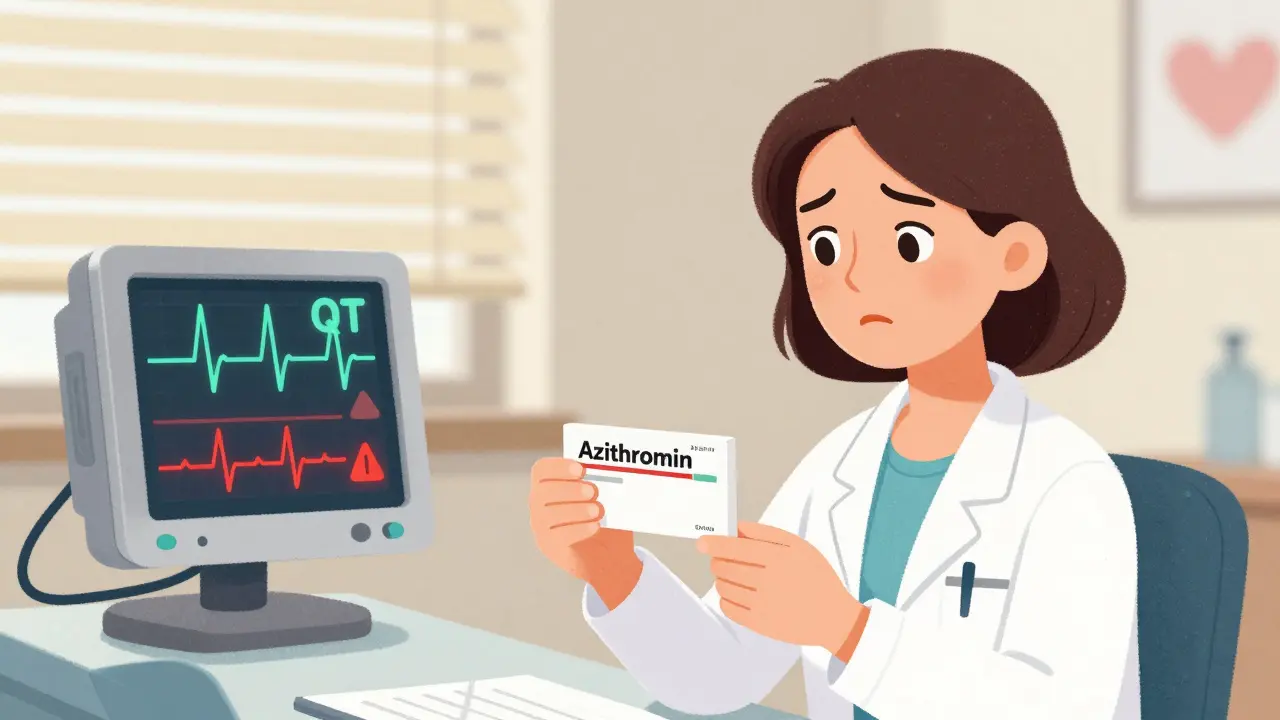
When you’re prescribed an antibiotic like azithromycin or clarithromycin, you probably don’t think about your heart. But these common drugs - used for pneumonia, bronchitis, and sinus infections - can quietly mess with your heart’s electrical rhythm. The risk isn’t high for most people, but for some, it’s life-threatening. The question isn’t whether macrolides are dangerous. It’s: who needs an ECG before taking them?
Why Macrolides Can Affect Your Heart
Macrolide antibiotics - azithromycin, clarithromycin, and erythromycin - work by stopping bacteria from making proteins. But they also block a specific potassium channel in heart cells called hERG. That’s the same channel that helps your heart reset after each beat. When it’s blocked, the heart takes longer to recharge. On an ECG, that shows up as a longer QT interval. A prolonged QT interval can lead to a dangerous arrhythmia called Torsades de Pointes. It’s rare, but it can cause sudden cardiac arrest.The risk isn’t the same across all macrolides. Erythromycin carries the highest risk - over four times more likely to cause QT prolongation than azithromycin. Azithromycin is the most commonly prescribed, and while its risk is lower, it’s still real. A 2012 study in the New England Journal of Medicine found people taking azithromycin had a 2.7 times higher risk of dying from heart problems compared to those taking amoxicillin. That’s not a small number. And it’s not just the drug itself. Factors like age, sex, kidney function, and other medications stack the deck.
Who’s at Highest Risk?
Not everyone needs an ECG. But if you have even one of these risk factors, your chance of a bad reaction goes up significantly:- Women - Female patients have nearly three times the risk of drug-induced QT prolongation compared to men.
- Age 65 or older - Older hearts are less forgiving. The risk jumps by more than double.
- Existing heart conditions - Past heart attack, heart failure, or a history of arrhythmias make you much more vulnerable.
- Low potassium or magnesium - These electrolytes keep your heart’s rhythm stable. Low levels from diuretics, vomiting, or poor diet increase danger.
- Other QT-prolonging drugs - Taking antidepressants, antifungals, antipsychotics, or even some stomach meds with macrolides multiplies the risk. One study showed a 4.1 times higher chance of arrhythmia when combined.
- Chronic kidney disease - Your kidneys clear these drugs. If they’re not working well, the drug builds up in your system.
Having two or more of these factors? Your risk isn’t just higher - it’s high enough that skipping an ECG is dangerous. One case reported in a Reddit thread described a 68-year-old woman with a baseline QTc of 480 ms. She was given clarithromycin for a chest infection. Five days later, she went into Torsades de Pointes. Emergency cardioversion saved her life. She had no prior heart diagnosis. Just age, female sex, and a borderline QT interval that was never checked.
When Is an ECG Required?
The British Thoracic Society (BTS) set the clearest standard: every patient starting long-term macrolide therapy needs a baseline ECG. That means people with cystic fibrosis, bronchiectasis, or chronic COPD who take azithromycin for months or years. Their guidelines say: no ECG, no prescription.But here’s the problem - most macrolides are given for short courses. A 5-day pill pack for a sinus infection. In those cases, the UK’s NHS says you only need to think about an ECG if the patient has risk factors. The American Heart Association updated its guidance in April 2025 with a 9-point scoring system that weighs age, sex, kidney function, and drug interactions. If your score is 4 or higher, get an ECG.
Here’s what the experts agree on:
- Always check QTc before starting long-term macrolide therapy (more than 14 days).
- Consider an ECG before short-term use if you’re over 65, female, or on other QT-prolonging drugs.
- Never start macrolides if your QTc is above 500 ms. That’s the red line. Risk jumps 5-7% for every 10 ms above 500.
- If your QTc is between 450-499 ms, proceed with caution. Repeat ECG in one month if therapy continues.

What the Numbers Really Mean
QTc values are measured in milliseconds. Normal is under 450 ms for men and under 470 ms for women. Anything over those numbers is prolonged. But here’s the catch - many doctors don’t know how to read ECGs properly. A 2024 study found that 42% of primary care physicians misread borderline values (470-499 ms). They think it’s fine. It’s not.Let’s say your QTc is 485 ms. That’s above the safe threshold for women. If you’re 70, on a diuretic, and taking an antifungal, that number becomes a warning siren. The absolute risk of Torsades de Pointes with macrolides is only 1-8 cases per 10,000 patient-years. But if your QTc is over 500 ms? That risk jumps to 3-5%. That’s not a statistical footnote. That’s a real, preventable death.
Why Most Doctors Don’t Order ECGs
You’d think with this much evidence, everyone would be screening. But here’s the reality:- Only 12% of primary care doctors in the UK order baseline ECGs for macrolides - even though they’re prescribed over 12 million times a year.
- 78% of GPs know about the risk, but 65% say they don’t have time.
- 58% say guidelines are unclear for short-term use.
- 47% think healthy patients are fine.
It’s not that doctors are careless. It’s that the system isn’t built for this. An ECG costs £28.50 in the UK. Screening all 12 million prescriptions would cost £342 million a year. That’s not feasible. So guidelines had to pick: screen everyone, or screen only those at risk. The BTS chose everyone for long-term use. The NHS chose risk-based for short-term. The result? A patchwork of care.
What’s Changing Now
Change is coming - slowly. The British Thoracic Society is testing handheld ECG devices in 15 clinics. These devices give results in under a minute. In pilot programs, the delay in starting treatment dropped from 5.2 days to just 0.8. That’s huge. Patients aren’t waiting. Doctors aren’t guessing.Electronic health records are catching up too. Epic Systems, used in 43% of U.S. hospitals, now flags macrolide prescriptions if the patient’s QTc is over 450 ms. It won’t stop the prescription - but it forces the doctor to pause and think.
The American Heart Association’s new 9-point scoring system is being adopted by major hospitals. It’s not perfect, but it’s better than nothing. It turns a vague “consider risk factors” into a clear number. Score 4 or higher? Get the ECG.

What You Should Do
If you’re prescribed a macrolide, here’s what to ask:- “Is this a long-term prescription?” If yes, insist on an ECG.
- “Do I have any risk factors?” List your age, sex, other meds, and any heart or kidney issues.
- “Can you check my QTc before I start?” If your doctor says no, ask why.
- “Is there a safer antibiotic?” Sometimes amoxicillin or doxycycline works just as well.
If you’re on a macrolide and feel dizzy, faint, or your heart races - stop the drug and get help immediately. Don’t wait. Don’t assume it’s just a side effect. It might be your heart trying to tell you something.
Bottom Line
Macrolides are useful. But they’re not harmless. The data is clear: ECG monitoring saves lives - but only when it’s done for the right people. You don’t need an ECG for every sore throat. But if you’re over 65, female, on multiple meds, or have kidney trouble - you do. The system isn’t perfect. But you can be the one who asks the question. One ECG. One conversation. Could be the difference between a routine prescription and a cardiac emergency.Do all macrolide antibiotics carry the same heart risk?
No. Erythromycin has the highest risk of QT prolongation - nearly five times more than azithromycin. Clarithromycin is in the middle. Azithromycin is the safest of the three, but it still carries a measurable risk, especially in people with other risk factors. Even though azithromycin is the most commonly prescribed, it’s not risk-free.
Can I get an ECG at my GP’s office, or do I need to go to a hospital?
Most GP clinics in the UK now have basic ECG machines. You don’t need to go to a hospital for a baseline reading. The test takes less than five minutes and is painless. If your doctor doesn’t have one, they can refer you to a local clinic or community health center. Many pharmacies also offer ECG services for a small fee.
What if my QTc is borderline - say, 475 ms?
A QTc of 475 ms is above the safe limit for women (470 ms) and borderline for men (450 ms). If you’re otherwise healthy and taking a short course, your doctor might still prescribe the antibiotic with caution. But if you’re over 65, on other meds, or have kidney issues, they should avoid macrolides or repeat the ECG after one month. Never ignore a borderline result - it’s a warning sign.
Are there alternatives to macrolides for people at risk?
Yes. For many infections, amoxicillin, doxycycline, or cephalexin are equally effective and don’t affect the QT interval. If you’re at risk, ask your doctor if one of these is an option. Don’t assume macrolides are the only choice - they’re often used out of habit, not necessity.
How often should I get an ECG if I’m on long-term macrolide therapy?
The British Thoracic Society recommends a baseline ECG before starting, then a repeat ECG after one month. After that, annual checks are advised if you continue the medication long-term. If you develop new symptoms like dizziness or palpitations, get checked immediately - don’t wait for your scheduled test.
Can I take macrolides if I have a pacemaker?
Having a pacemaker doesn’t automatically protect you from QT prolongation. Pacemakers control heart rate, but they don’t prevent the electrical instability that leads to Torsades de Pointes. If you have a pacemaker and are prescribed a macrolide, you still need a baseline ECG. Your doctor will need to check both your device settings and your QT interval.
What should I do if I’ve already taken a macrolide without an ECG?
If you’ve taken a short course (5-7 days) and felt fine, you’re likely okay. But if you were on it longer, or you have risk factors like age, kidney disease, or other medications, ask your doctor for an ECG now. It’s not too late. Many people have undiagnosed Long QT Syndrome - and an ECG can catch it before the next prescription.




Jessica Salgado
16 Dec 2025 at 18:10I had no idea macrolides could mess with your heart like that. My grandma was on azithromycin last year for pneumonia and she got dizzy outta nowhere-doc just said 'it's a side effect.' Now I'm terrified she almost died and no one checked her QTc. 😳