

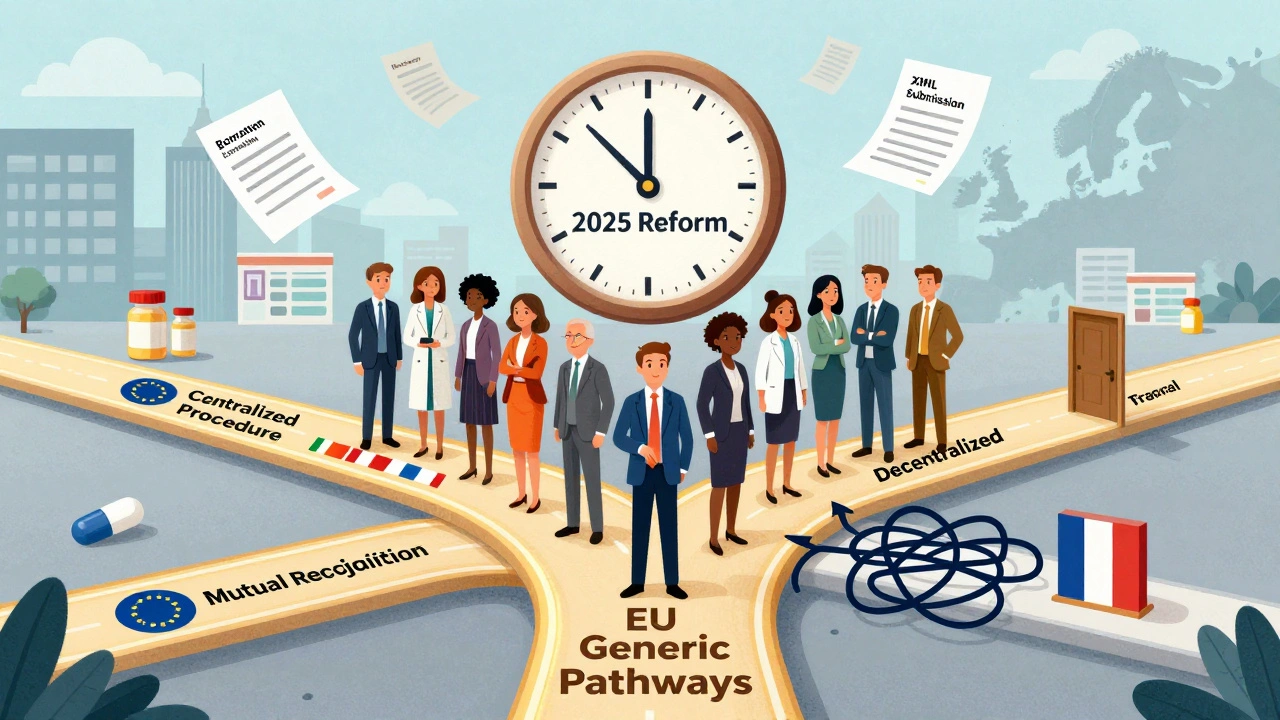

When you pick up a generic pill at the pharmacy in Berlin, Rome, or Warsaw, you might think it’s just a cheaper version of the brand-name drug. But behind that simple label lies one of the most complex regulatory systems in the world. In 2025, the European Union’s approach to generic medicines is changing faster than ever-reshaping how drugs reach patients, how companies compete, and how quickly prices drop. The system isn’t broken, but it’s far from simple. And if you’re trying to bring a generic drug to market in Europe, you’re not just dealing with one set of rules. You’re navigating four different pathways, 27 national bureaucracies, and a major overhaul that just took effect.
Four Ways to Get a Generic Drug Approved in the EU
There’s no single path to launch a generic medicine in the EU. Instead, manufacturers must choose from four approval routes, each with different costs, timelines, and risks. The choice isn’t just logistical-it’s strategic.
The Centralized Procedure is the fastest route to EU-wide access. You submit one application to the European Medicines Agency (EMA), and if approved, your drug can be sold in all 27 EU countries plus Iceland, Liechtenstein, and Norway. Sounds ideal, right? But it’s also the most expensive. Application fees alone hit €425,000, and with consultancy, testing, and documentation, total costs can climb to €1.8 million. That’s only worth it for high-volume drugs expected to earn over €250 million annually across the bloc. Sandoz used this route to launch its version of Novartis’s Cosentyx in Q2 2025-11 months faster than any other method allowed.
The Mutual Recognition Procedure (MRP) is the middle ground. You get approval in one country first-the Reference Member State-then ask others to recognize it. About 42% of generics use this route. It’s cheaper than the Centralized Procedure, costing between €180,000 and €220,000. But it’s slower than it should be. Even though the official clock says 90 days for consensus, the average takes 132.7 days. Why? Because countries keep adding their own demands. Teva’s generic rosuvastatin got approved in Germany but waited 8.2 months before hitting the Dutch and Belgian markets due to pricing delays.
The Decentralized Procedure (DCP) lets you apply to multiple countries at once. It’s used by 38% of applicants. But it’s messy. The Reference Member State leads the review, but other countries can raise objections-and each objection resets the 210-day clock. In 2024, 37% of DCP applications faced delays over six months, mostly because Eastern European regulators interpreted quality standards differently. One case study from the GMDP Academy showed a single impurity threshold dispute delayed approval in five countries for nine months.
The National Procedure is the simplest-but also the most limited. You apply only to one country. It’s used for just 5% of applications, mostly when a company wants to test the waters in a high-reimbursement market like France. But it doesn’t help with scale. Accord Healthcare took 197 days to get approval in France via this route-while using MRP, they got the same drug approved across five countries in 142 days.
What the EU Pharma Package 2025 Changed
On June 4, 2025, the EU passed its biggest update to generic drug rules in 20 years: the Pharma Package. It didn’t just tweak a few forms. It rewrote the game.
One of the biggest shifts is the expanded Bolar exemption. Before, generic makers could start negotiating prices and reimbursement only two months before a patent expired. Now, they can start six months earlier. That’s not just a technical change-it’s a power shift. Payers now have more time to compare prices, and manufacturers have to submit their HTA dossiers earlier. REMAP Consulting estimates this alone will cut generic launch delays by 4.3 months on average. But there’s a catch: earlier entry means more competition before launch, which could drive down prices by 12-18%.
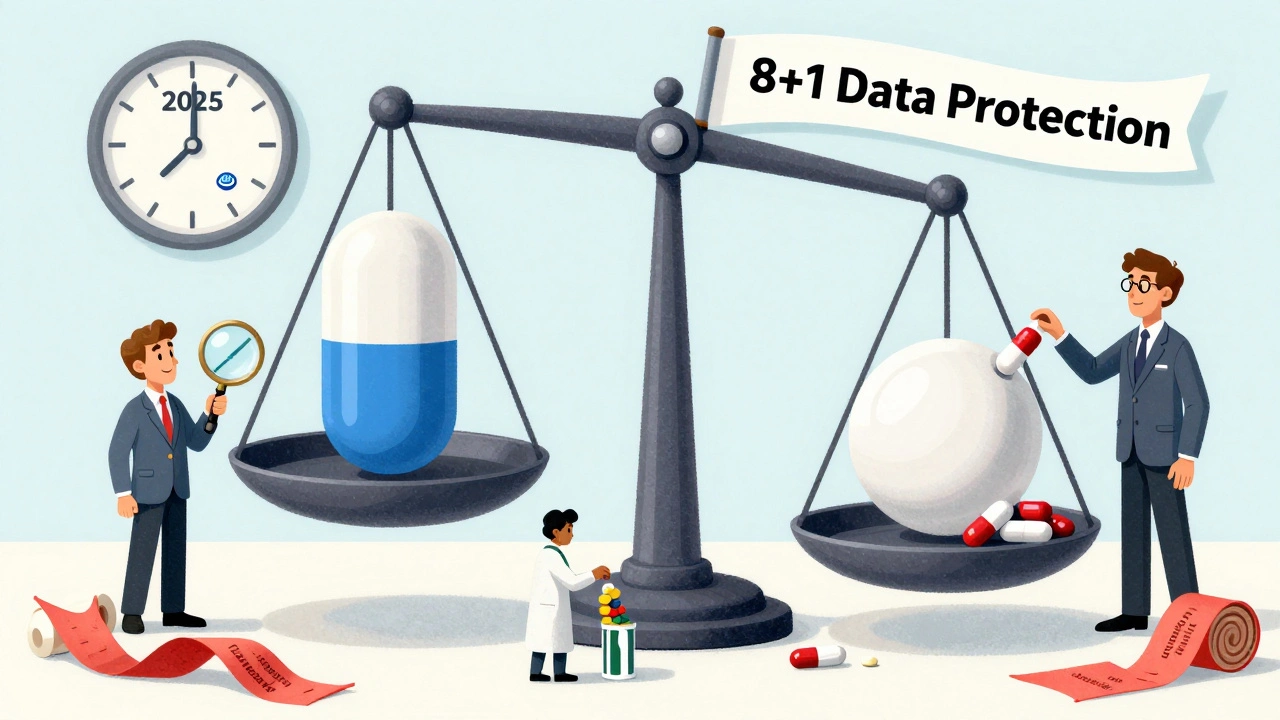
Another major change is the reduction in data protection. Previously, originator companies had 10 years of exclusivity (8 years of data protection + 2 years of market exclusivity). Now, it’s 8 years of data protection + 1 year of market protection-with a possible one-year extension if the drug meets public health targets. That means generics can enter sooner. Evaluate Pharma predicts this will speed up access for 78 high-value biologics currently in development.
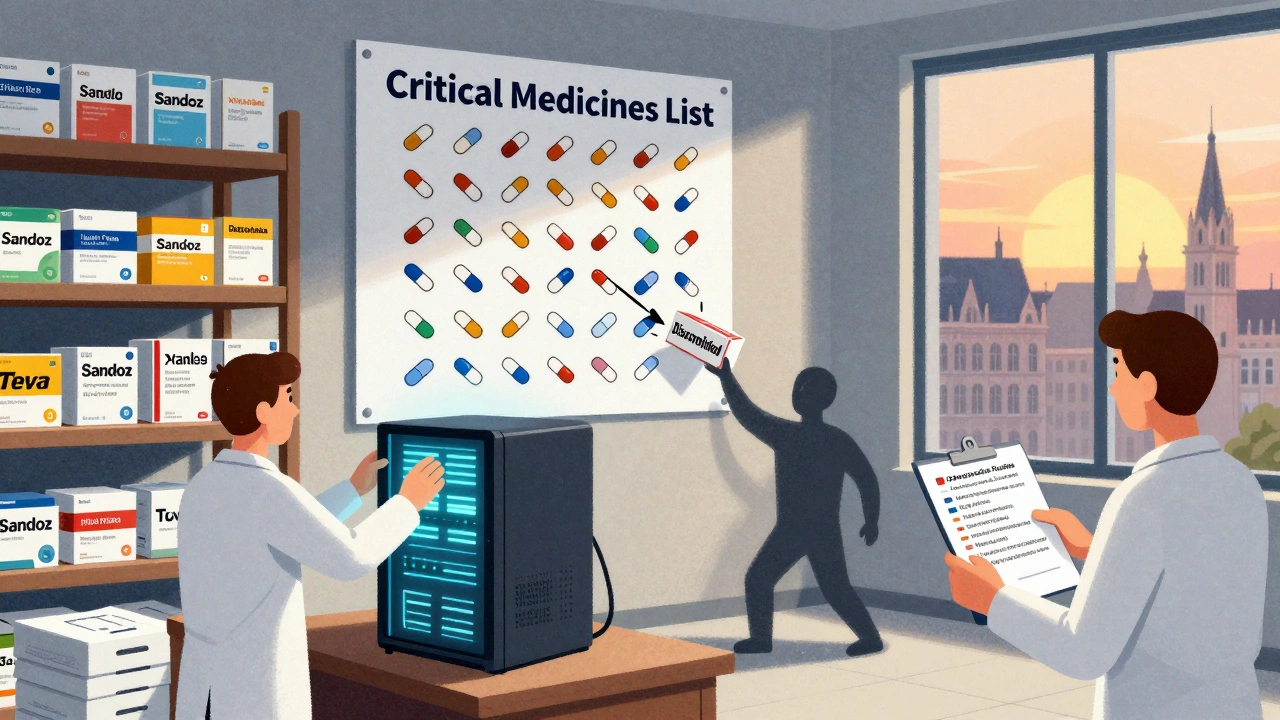
There’s also a new obligation to supply rule. Companies can’t just stop making a generic because it’s not profitable. If a drug is on the EU’s list of critical medicines, manufacturers must keep producing it in “sufficient quantities.” But here’s the problem: each country defines “sufficient” differently. Professor Panos Kanavos of LSE Health warns this could lead to artificial shortages in smaller markets if regulators interpret the rule too loosely.
Why National Differences Still Matter
Even with harmonization efforts, national regulators still call the shots on key details. The EMA sets the baseline-but countries add their own layers.
Germany’s BfArM requires extra pharmacodynamic studies for complex generics like inhalers, even if the EMA says they’re not needed. France’s ANSM demands specific pediatric formulation data that other countries don’t require. Poland and Romania have stricter rules for impurity profiles in older reference products. A 2025 survey by the Association of the British Pharmaceutical Industry found that 68% of generic companies saw inconsistent bioequivalence requirements across borders as their biggest headache.
And then there’s documentation. By 2026, all product information must be submitted electronically in XML format. That means companies need new software, training, and IT support. White & Case estimates this will cost €180,000-250,000 per company to implement. Smaller firms are feeling the pressure.
Even the EMA’s own guidance isn’t always followed. A 2025 industry survey showed 58% of respondents got conflicting answers from national authorities compared to EMA guidelines-especially around impurity limits and stability testing. One company spent 11 months chasing down a single impurity threshold that varied by country, even though the EMA had approved the drug.
Who’s Winning in the EU Generic Market?
The EU generic market was worth €42.7 billion in 2024, growing 6.2% from the year before. But the winners aren’t who you might expect.
Indian manufacturers now hold 38% of all EU generic approvals-up from 29% in 2020. Their low-cost production and aggressive pricing have made them dominant in volume-driven markets. Meanwhile, European firms like Sandoz and Viatris still control 52% of the market-not because they’re cheaper, but because they play the long game. They use the Centralized Procedure to launch across the entire EU at once, avoiding the delays of national negotiations.
Eastern Europe is the fastest-growing region, with generic sales rising 9.8% annually. That’s partly because prices are lower, and reimbursement systems are expanding. But it’s also because regulators there are more open to accepting generics approved elsewhere-making it easier for companies to use MRP or DCP to enter the region.
And the US-EU Framework Agreement, effective September 1, 2025, could change the game again. It adjusts tariffs on key pharmaceutical ingredients. The exact impact isn’t clear yet, but if it lowers costs for API imports, it could give Indian and Chinese manufacturers an even bigger edge.
What’s Next for Generic Manufacturers?
If you’re planning to launch a generic in Europe in 2025 or beyond, here’s what you need to do:
- Choose your pathway carefully. If your drug will sell over €250 million in the EU, go Centralized. If you’re targeting 3-5 countries, use MRP. Avoid DCP unless you’re confident in your regulatory team’s ability to handle national objections.
- Start early. The EMA now recommends 15-18 months of preparation for Centralized submissions. That includes 6-8 months just for bioequivalence studies under the 2025 guidelines.
- Prepare for price pressure. With the Bolar exemption, you’ll be negotiating with payers six months before launch. Have your HTA dossier ready. Know your cost structure. Don’t assume you’ll get the same price everywhere.
- Invest in compliance. The move to ePI in XML format isn’t optional anymore. Budget for software, training, and audits. One company missed the 2026 deadline and had to delay three launches.
- Watch the list. The Critical Medicines Act now includes 200 essential generics. If your drug is on it, you’ll need to prove you can supply it consistently-or risk being blocked.
The EU’s goal is clear: more generics, faster access, lower prices. But the system isn’t designed for speed-it’s designed for safety. And that means complexity. The companies that win won’t be the ones with the cheapest pills. They’ll be the ones who understand the rules, adapt to the changes, and play the long game.
What Happens After 2026?
The big changes don’t stop in 2025. On July 1, 2026, the revised Regulatory Data Protection rules fully kick in. That’s when the 8+1 protection period becomes standard. That means more generics will enter the market sooner-especially for complex drugs that were previously protected for longer.
But there’s a risk. Professor Kanavos points out that the 1-year default market protection may discourage investment in complex generics like biosimilars for rare diseases. If the return isn’t worth the cost, companies might walk away. That could create new access gaps.
The EU is trying to balance innovation and affordability. But the tension remains. As generic manufacturers adapt, the real question isn’t just how fast they can get approved-it’s whether the system will still be able to deliver the medicines patients need, when they need them.
How long does it take to get a generic drug approved in the EU?
Approval times vary by pathway. The Centralized Procedure takes about 210 days for scientific review, plus 46 days for European Commission approval under the 2025 rules. The Mutual Recognition Procedure averages 132.7 days, though delays often push it to 180+ days. The Decentralized Procedure takes 247 days on average due to coordination issues. National procedures range from 180 to 240 days. The 2025 reforms aim to cut these times, but national bottlenecks still cause delays.
What’s the difference between generic and biosimilar drugs in the EU?
Generics are chemically identical copies of small-molecule drugs. Biosimilars are highly similar to complex biological drugs (like antibodies) but not identical. The EU requires stricter testing for biosimilars, including clinical trials. While generics follow the same approval pathways, biosimilars must use the Centralized Procedure and are subject to separate guidelines under EMA’s 2023 Biosimilar Regulation.
Can a generic drug be approved faster in one EU country than another?
Yes. Even with harmonized rules, national regulators can impose additional requirements. For example, Germany requires extra pharmacodynamic studies for inhalers, and France demands pediatric formulation data. These differences can delay approval even after EMA approval. That’s why companies often use the Centralized Procedure to avoid country-by-country delays.
Why are Indian companies dominating EU generic approvals?
Indian manufacturers have lower production costs, strong regulatory experience, and aggressive pricing strategies. They’ve focused on high-volume, low-margin generics and leveraged the Mutual Recognition and Decentralized Procedures to enter multiple markets efficiently. In 2024, they secured 38% of all EU generic approvals, up from 29% in 2020.
What happens if a generic drug manufacturer stops producing a drug?
Under the 2025 Critical Medicines Act, manufacturers of drugs on the EU’s 200-item essential medicines list must continue supplying them in "sufficient quantities." If they stop without justification, national authorities can intervene, force production, or even suspend their marketing authorization. This rule was added to prevent shortages, but enforcement varies by country.
How do the new EU rules affect drug prices?
The expanded Bolar exemption allows payers to start negotiations six months before patent expiry, increasing competitive pressure. Evaluate Pharma predicts this will reduce generic launch prices by 12-18%. The 2025 reforms also aim to reduce the 22.4-month gap between US and EU generic launches, which should further drive down prices over time.
Generic drugs are no longer just about saving money-they’re about navigating a shifting legal landscape, managing national differences, and staying ahead of regulatory deadlines. The EU’s system isn’t perfect, but it’s getting smarter. The companies that succeed will be those who treat regulation not as a barrier, but as part of their strategy.





Augusta Barlow
4 Dec 2025 at 16:03Okay but let’s be real-this whole EU generic system is just a front for Big Pharma to keep control. The ‘critical medicines’ list? Total distraction. They know if they make it sound like public health, no one questions the real agenda: lock in monopolies under the guise of ‘safety.’ And don’t get me started on the XML requirement. That’s not compliance-it’s a paywall for small labs. Who’s building that software? Big tech firms owned by the same investors who own the originators. It’s all connected. The 2025 reforms? Just a glittery cage.
They say ‘faster access’ but the real goal is to make sure only the players with enough cash to hire 17 regulatory consultants survive. And don’t even mention India. They’re not ‘dominating’-they’re being used as a pressure valve so the EU can pretend it’s not protecting its own oligarchs. Wake up.
I’ve seen this before. Remember when the FDA ‘streamlined’ approvals? Then every single generic got pulled off shelves for ‘quality issues’ six months later. Coincidence? I think not. The EU is just copying the playbook. They don’t want more generics. They want the right generics. And the right ones always have the right shareholders.
That ‘expanded Bolar exemption’? That’s not to help patients. It’s to let payers drag out negotiations until the generic company goes broke trying to fund the HTA dossier. Then they buy the IP cheap. It’s not regulation. It’s predation dressed in policy.
And the ‘obligation to supply’? Please. Who’s auditing that? Who’s even checking if ‘sufficient quantities’ means one pill per month in Latvia? The system’s rigged. And the people writing this article? They’re part of the machine. They don’t see the strings. They just admire the puppet show.
Next thing you know, they’ll require a notarized letter from your grandmother proving you actually need the medicine. And it’ll be ‘for your own good.’