

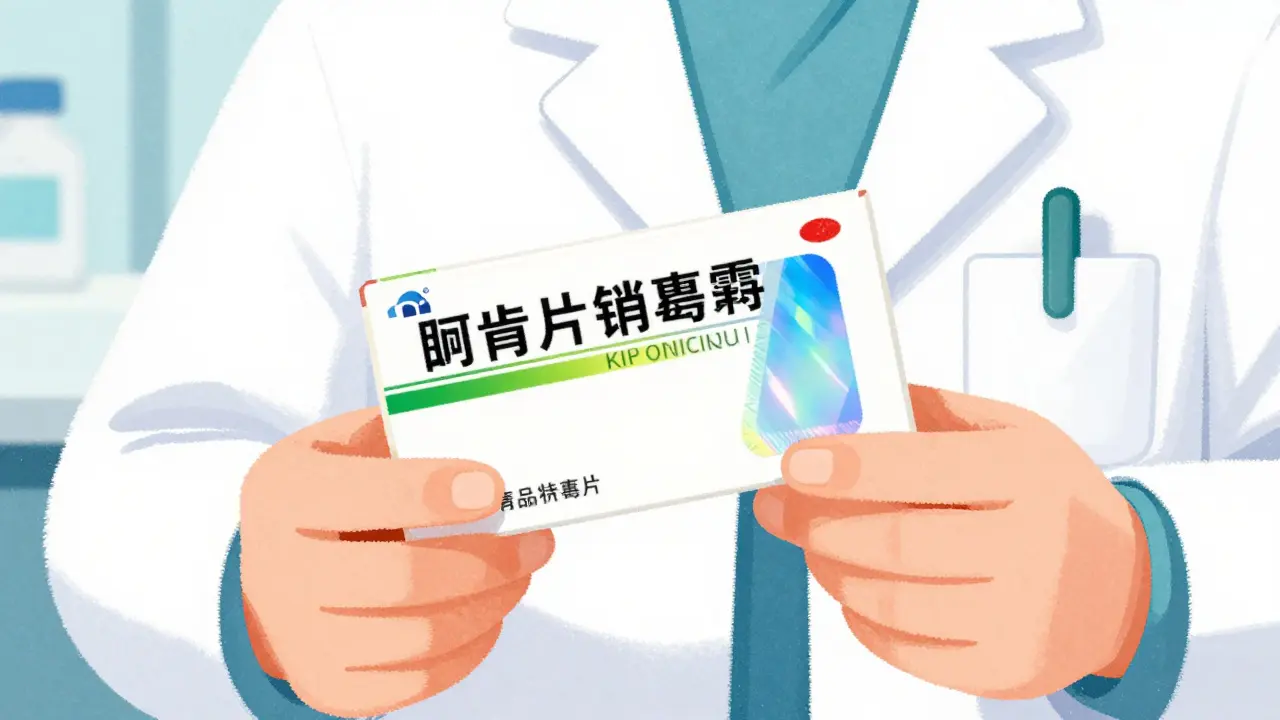

Imagine picking up a prescription for a common generic drug, only to find out later that the pills inside are essentially chalk or, worse, a dangerous chemical cocktail. It happens more than you'd think. According to the World Health Organization, counterfeit medicines make up nearly 10% of the global pharmaceutical market. When it comes to generic drugs, the risk is often higher because these products have thinner profit margins, meaning manufacturers might not invest as heavily in high-end security as they do for big-name brands.
The real danger isn't just that the medicine won't work; it's that counterfeit medicines are substandard or falsified pharmaceutical products that deliberately misrepresent their identity or source. This can lead to treatment failure or sudden drug resistance. To protect yourself and your patients, you need a multi-layered approach to verification. You can't rely on just one "trick," because modern counterfeiters are incredibly good at mimicking the look of a real box.
Quick Guide to Verification Methods
If you're in a rush, here is the baseline for checking if a generic drug is the real deal. Most professionals use a "triad" of checks: visual (overt), tool-based (covert), and digital (track-and-trace).
| Method | Example Feature | Difficulty to Fake | Tool Required |
|---|---|---|---|
| Overt | Holograms / Color-shift ink | Low to Medium | None (Visual) |
| Covert | UV-sensitive inks | Medium to High | UV Lamp (365nm) |
| Track-and-Trace | GS1 Serial Numbers | High | Barcode Scanner/App |
| Analytical | NIR Spectroscopy | Very High | Spectrometer |
Spotting the Fakes: Overt Packaging Features
Overt features are the things you can see with your naked eye. They are the first line of defense, but they are also the easiest for criminals to copy. For example, many high-end generics use Optically Variable Ink (OVI), which changes color as you tilt the package-like shifting from green to blue. You'll also see holograms with micro-texts so small (often 50-100 micrometers) that they require a magnifying glass to read clearly.
But here is the catch: INTERPOL has reported that sophisticated counterfeiters can replicate these holograms with 80-90% accuracy. A common red flag reported by pharmacists on platforms like Reddit is subtle typography. Keep an eye on the font of the expiration date or the lot number. If the ink looks slightly bled or the font weight is inconsistent with previous batches of the same generic, it's a major warning sign.
Going Deeper with Covert Security
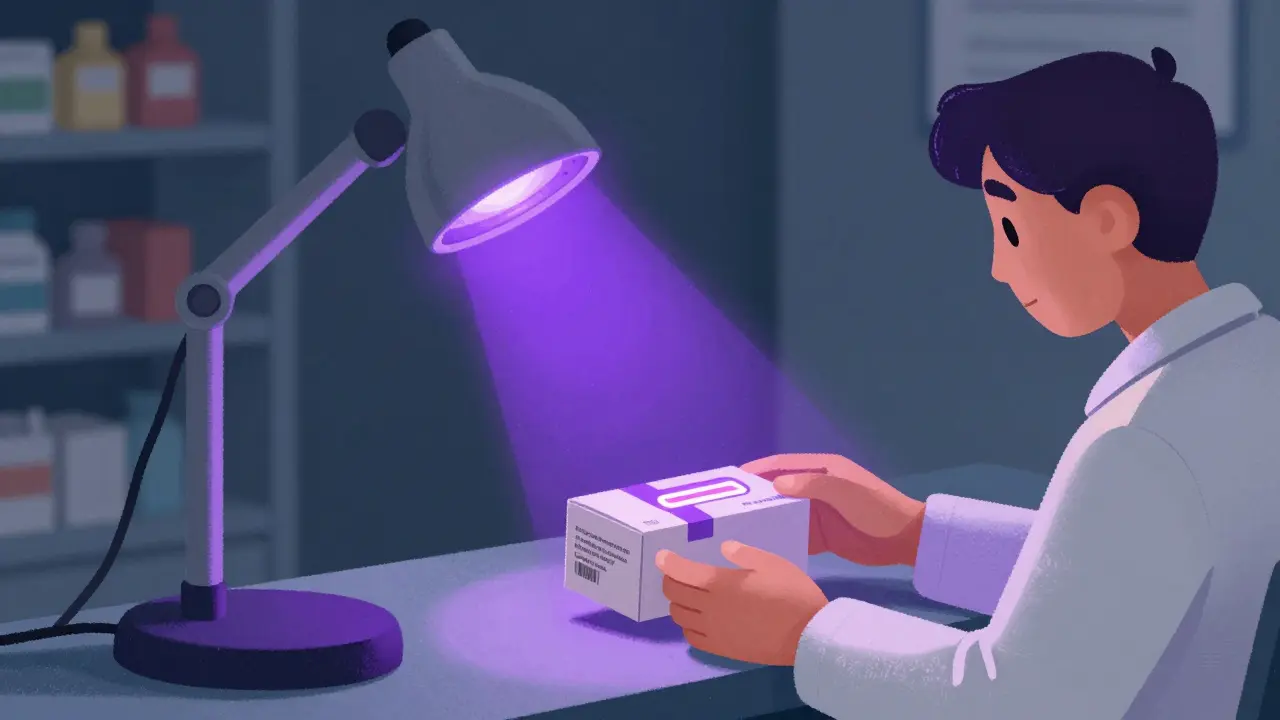
When visual checks aren't enough, we move to covert features. These are "hidden" security markers that require a simple tool to see. A great example is UV-sensitive ink. Some manufacturers, such as Johnson & Johnson, have used inks that only glow under a specific 365nm ultraviolet light. If you shine a UV lamp on the box and the secret marker doesn't appear-or it's the wrong color-you're likely looking at a fake.
Beyond light, some packaging includes RFID tags operating at 13.56 MHz. These allow a pharmacy to verify the product without even opening the box. There are also chemical taggants, like Lumilink® UV markers, which can be scanned by handheld readers costing a few hundred dollars. These are much harder to fake because the criminal would need the exact chemical formula and the specific reader to test their work.
The Digital Shield: Track-and-Trace Systems
The gold standard for supply chain security is the track-and-trace system. This is where GS1 Standards come into play. Every single box gets a unique serial number. In the EU, the Falsified Medicines Directive (FMD) has made this mandatory for prescription drugs. When a pharmacist scans the 2D data matrix code, the system checks it against a central database to ensure that specific box hasn't been sold already or reported stolen.
However, this isn't perfect. While the European Medicines Verification System (EMVS) is incredibly reliable, many generic drugs suffer from "inconsistent serialization." This means that while the brand-name version of a drug is perfectly tracked, the generic version might have gaps in its digital trail. In some developing regions, poor network connectivity makes these apps fail up to 40% of the time, forcing people back to the risky method of just "looking at the box."
The Science of Certainty: Analytical Verification
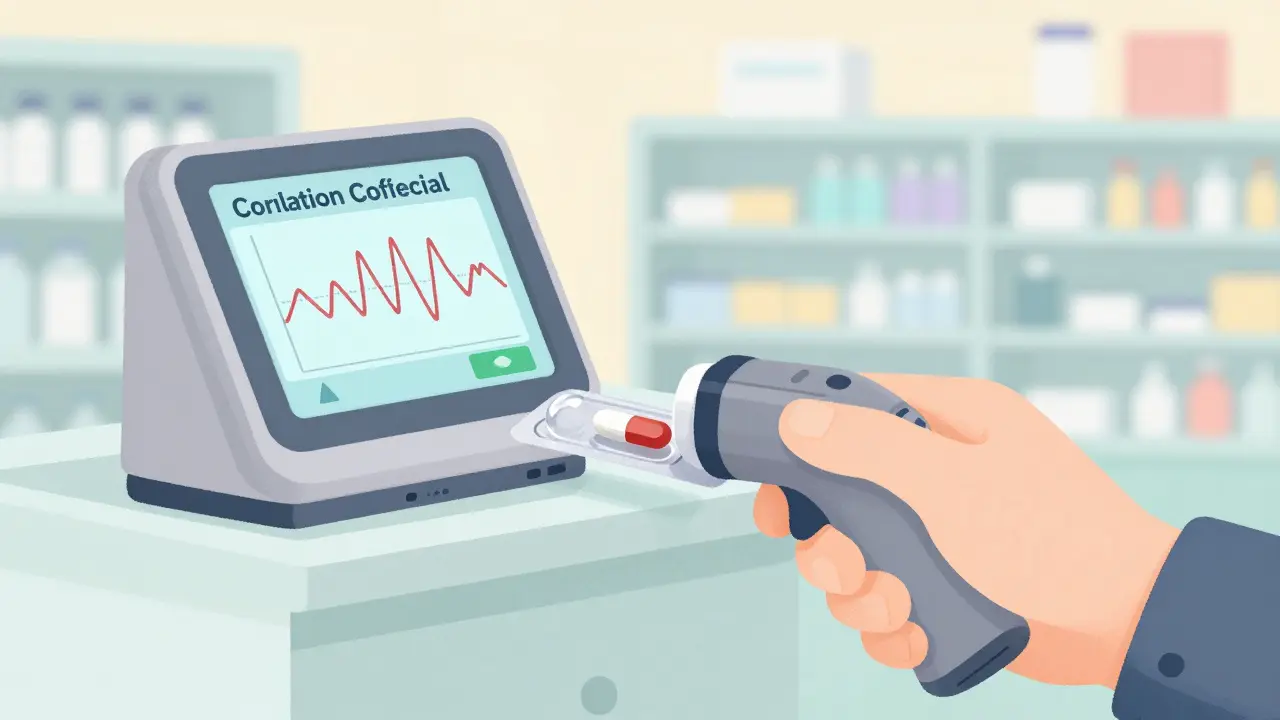
If you absolutely must know if the medicine inside is authentic, you stop looking at the packaging and start looking at the molecules. This is where NIR Spectroscopy (Near-Infrared) comes in. A handheld device like the Thermo Fisher® TruScan® RM can scan a tablet through its blister pack in about 10 to 30 seconds. It measures how light interacts with the chemical bonds of the drug.
Experts use a "correlation coefficient" to determine authenticity. If the scan of the unknown pill matches the reference sample with a coefficient below 0.85, it's almost certainly a counterfeit. While Raman Spectroscopy is also used, it can struggle with dark-colored tablets because of fluorescence interference. NIR is generally the more versatile field tool, though the equipment is an investment, typically ranging from $15,000 to $50,000.
Putting it All Together: A Risk-Based Approach
No single method is a silver bullet. The FDA suggests a multi-layered approach. If you are a community pharmacist or a healthcare provider, don't just scan the barcode. Combine your methods. A study published in PMC showed that using both visual checks and spectroscopic verification caught 98.7% of counterfeits, compared to only 82.4% when using just one method.
The roadmap for the next few years is moving toward AI and blockchain. The FDA is already piloting blockchain systems that track generics through four different distribution tiers with 99.2% accuracy. By 2026, the goal is to have 100% serialization for all generic medicines in the U.S. This will close the gap between the security of branded drugs and their generic counterparts.
Why are generic drugs more likely to be counterfeited than branded ones?
Generic drugs often have lower profit margins, which means manufacturers may spend less on expensive security features like high-end holograms or RFID tags. Additionally, generic supply chains are often more complex, passing through 5-7 distribution points compared to 3-4 for branded drugs, creating more opportunities for fake products to enter the stream.
Can I verify a generic drug using just a smartphone app?
Smartphone apps are great for scanning GS1 barcodes and checking serial numbers via track-and-trace systems. However, they cannot verify the chemical composition of the drug. Since sophisticated counterfeiters can now replicate packaging and barcodes with up to 95% accuracy, an app can tell you the box is "valid," but it can't tell you if the pill inside is real. Analytical tools like NIR spectroscopy are needed for that.
What is the "0.85 correlation coefficient" in drug testing?
In NIR spectroscopy, the device compares the light spectrum of a sample against a known authentic reference. The correlation coefficient measures how closely these two spectra match. A value of 1.0 is a perfect match. If the value drops below 0.85, it indicates a significant physicochemical difference, signaling that the product is likely a counterfeit or substandard.
What should I do if I suspect a generic medicine is fake?
First, quarantine the product so it isn't dispensed to patients. Document the lot number, expiration date, and any visual anomalies. Contact the manufacturer through their authentication portal and report the incident to your national regulatory body (such as the FDA in the US or the MHRA in the UK). Do not discard the packaging, as it is primary evidence for forensic analysis.
Are holograms still a reliable way to verify authenticity?
They are a good first check, but not a guarantee. While high-quality holograms with nano-text are hard to copy, INTERPOL's Operation Pangea has shown that many can be replicated with 80-90% accuracy. They should be used as one part of a larger verification strategy, not the sole proof of authenticity.
Next Steps for Pharmacy Managers
If you're running a clinic or pharmacy, start by auditing your current process. Do you have a UV lamp for covert checks? Are your staff trained to spot font inconsistencies? For those with a higher budget, investing in a handheld spectrometer can virtually eliminate the risk of dispensing fakes. If that's too expensive, establish a relationship with regional verification centers or use manufacturer-specific portals to verify suspicious batches. Remember, the goal isn't a perfect system-since that doesn't exist-but a multi-layered one that makes it too expensive and difficult for counterfeiters to succeed.



Hudson Nascimento Santos
5 Apr 2026 at 07:58It is fascinating how we trust the chemical composition of a pill based on a piece of cardboard and some ink. We are essentially shifting our faith from the physician to the supply chain logistics manager. This digital shield is just a new form of blind trust in the system.