



Feeling bloated after lunch? That tightness in your stomach, the pressure, the urge to burp but nothing comes out? You’re not alone. Over 20 million Americans reach for an OTC gas remedy at least once a month. And most of them pick between two types: simethicone or enzyme products like Beano or Lactaid. But here’s the thing-these aren’t the same thing. One works fast, the other works smart. Knowing the difference can save you money, time, and discomfort.
What Simethicone Actually Does (And Doesn’t Do)
Simethicone isn’t a magic pill that stops gas from forming. It doesn’t kill bacteria. It doesn’t digest beans or dairy. What it does is simpler: it breaks up gas bubbles.
Think of your gut like a soda bottle shaken up. Tiny bubbles cling together, making you feel swollen and full. Simethicone is like a drop of dish soap in that bottle-it reduces the surface tension so those little bubbles merge into bigger ones. Bigger bubbles rise faster. They’re easier to burp out or pass as flatulence.
This is why it works so fast. Most people feel relief in 15 to 30 minutes. No waiting. No digestion required. That’s why Gas-X, Mylicon, and Phazyme are go-to choices for airplane rides, date nights, or post-meal discomfort. The active ingredient? A silicone-based polymer that never gets absorbed into your bloodstream. It just travels through your gut and exits unchanged. That’s why it’s safe for babies, pregnant women, and seniors.
But here’s the catch: if you’re still eating the foods that cause gas-beans, broccoli, dairy, carbonated drinks-simethicone won’t stop the next wave. It’s a cleanup crew, not a fire extinguisher.
Enzyme Products: Stop Gas Before It Starts
Enzyme products take the opposite approach. Instead of managing bubbles, they stop gas from forming in the first place.
Lactase, the enzyme in Lactaid and Dairy Digest, breaks down lactose-the sugar in milk. If you’re lactose intolerant, your body doesn’t make enough of it. Undigested lactose heads to your colon, where bacteria feast on it and produce gas, bloating, and cramps. Take lactase right before eating dairy, and you prevent that fermentation entirely. Studies show it works in over 85% of people when taken correctly.
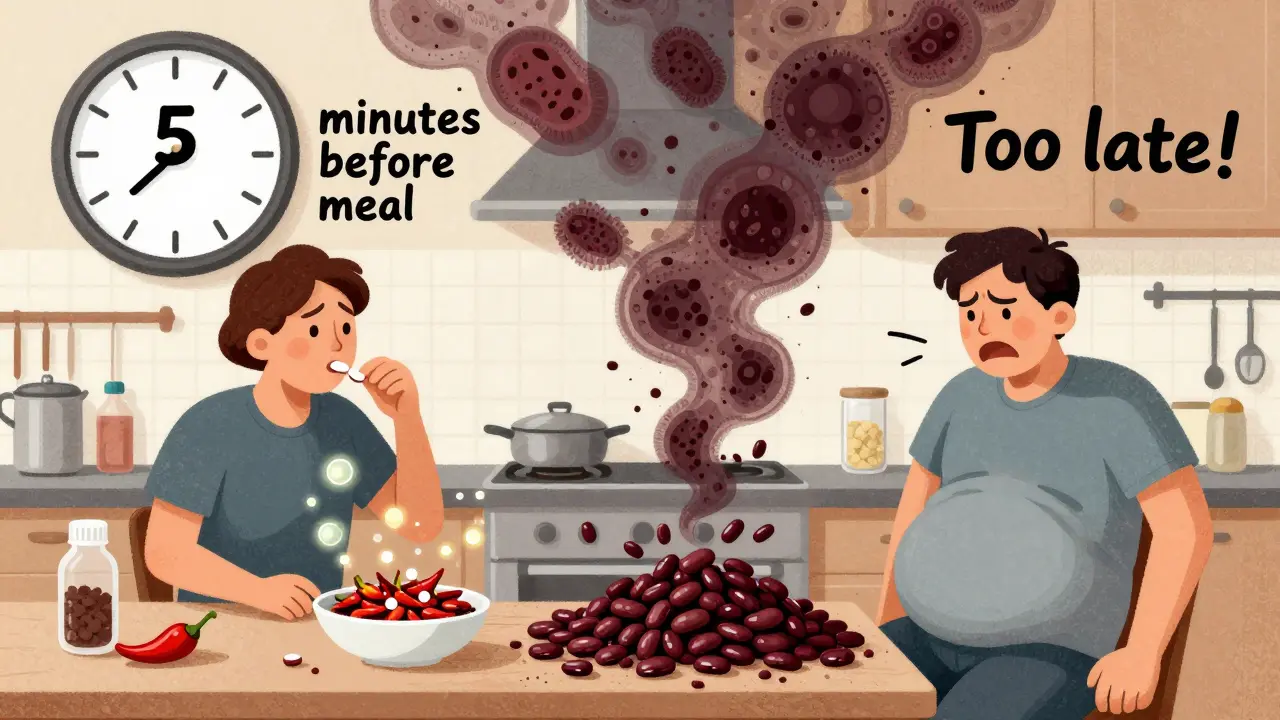
Then there’s alpha-galactosidase-the enzyme in Beano. It breaks down complex carbs found in beans, lentils, cabbage, and Brussels sprouts. These carbs, called oligosaccharides, are indigestible by humans. Bacteria love them. Beano gives your body a hand to digest them before they reach the colon. But timing matters. Take it 5 to 10 minutes before your meal. Miss that window? It’s useless.
Here’s the reality check: Beano doesn’t work for everyone. Some people’s gut bacteria are too aggressive. Others eat foods with too many different complex carbs. Clinical studies show effectiveness between 45% and 78%. It’s not a guarantee. But for those it helps? It’s life-changing.
Simethicone vs Enzymes: When to Use Which
Let’s cut through the noise. Here’s how to choose:
- Use simethicone when you’re already bloated, gassy, or uncomfortable. It’s your emergency button. Perfect for unexpected meals, dining out, or after eating something you know will bother you.
- Use enzymes when you know what’s coming. Planning a bean chili night? Take Beano before you start eating. Going out for pizza? Take lactase with your first bite.
One study of 247 people found simethicone relieved symptoms in 73.5% of cases within 30 minutes. Another study of 189 IBS patients found simethicone didn’t help much more than a placebo. Why? Because IBS bloating isn’t always from gas-it’s from gut sensitivity. Simethicone doesn’t fix that.
Enzymes? They’re more predictable for known triggers. Lactase works consistently for lactose intolerance. Alpha-galactosidase? Less so. It depends on your microbiome, the food, and how much you take.
Dosing, Safety, and What the Experts Say
Simethicone dosing is simple: 40 to 125 mg after meals and at bedtime. You can take up to four doses a day, max 500 mg total. Chewable tablets need to be chewed. Softgels can be swallowed whole. Liquid drops (like Mylicon for babies) are easy to measure. No side effects. No drug interactions. Even if you take too much, it just passes through.
Enzymes require precision. Lactase needs 3,000 to 9,000 FCC units per meal. Beano requires 450 to 1,200 GalU. Too little? No effect. Too much? Usually harmless, but wasteful. Always take them right before eating. Don’t wait. Don’t chew them if the label says swallow-some are enteric-coated to survive stomach acid.
Doctors agree: simethicone is the gold standard for immediate relief. The National Institute of Diabetes and Digestive and Kidney Diseases gives it a “Recommended” rating with the highest level of evidence. But they’re clear: enzymes are only “strongly recommended” for diagnosed lactose intolerance. For Beano? “Conditionally recommended.”
Dr. Michael Camilleri of Mayo Clinic puts it bluntly: “Simethicone works fast and is safe. That’s why it’s everywhere.” But he also warns: “Marketing makes it sound like it prevents gas. It doesn’t.”
Real People, Real Results
On Amazon, Gas-X has over 18,000 reviews with a 4.5-star rating. The top comments? “Works in minutes.” “Saved my flight.” “I keep it in my purse.”
Beano? 4.2 stars from nearly 7,000 reviews. Positive reviews say: “I can finally eat chili again.” Negative ones say: “Didn’t work for my beans.” One user wrote: “I take it with lentils and it’s perfect. With broccoli? Nothing.”
Reddit’s r/GIhealth has hundreds of threads. One user summed it up: “Simethicone is my emergency button. Beano is my daily tool. I use both.” That’s the smart approach.
Price-wise, Gas-X (200 tablets) costs about $12.50 at CVS. Beano (100 tablets) is $19. Lactaid is $15 for 100 tablets. If you use it daily, cost adds up. But if it lets you eat what you love? Worth it.

What’s New in Gas Relief
The market is changing. Combination products-simethicone plus enzymes-are growing fast. Gas-Zyme, for example, has seen 18.7% sales growth in the last year. It’s a one-two punch: prevent gas with enzymes, then clear bubbles with simethicone.
Even more exciting? Personalized solutions. Viome’s gut microbiome test, launched in late 2023, analyzes your gut bacteria and tells you exactly which enzymes you need. No more guessing. You might find out you need lactase but not Beano-or vice versa.
Researchers are also testing new forms of simethicone that last longer. Current versions work 2 to 3 hours. New microencapsulated versions in clinical trials promise up to 8 hours of relief. That could mean one dose for all-day comfort.
When to Skip OTC Remedies
OTC gas relievers are great for occasional discomfort. But if you’re bloated every day, have pain, diarrhea, weight loss, or blood in your stool-see a doctor. These aren’t signs of simple gas. They could be IBS, SIBO, celiac disease, or something more serious.
Dr. Robynne Chutkan, a gastroenterologist, says: “OTC gas remedies are band-aids on bullet wounds. Fix the diet first.” That’s true. Cutting back on carbonated drinks, chewing slowly, avoiding gum, reducing artificial sweeteners, and limiting FODMAPs can reduce gas more than any pill.
But for most people? OTC remedies are part of the solution-not the whole thing.
Final Takeaway: Use the Right Tool for the Job
Simethicone is your quick fix. Enzymes are your prevention plan. Neither cures the root cause-but they don’t have to. For most people, occasional bloating is normal. You don’t need to eliminate beans or dairy forever. You just need the right tool when you need it.
Keep simethicone handy for surprise bloat. Keep enzymes in your pantry for planned meals. Use both together if you want maximum coverage. And remember: if you’re constantly relying on them, it’s time to look deeper. But for now? You’ve got options. And now you know how to use them.
Is simethicone safe to take every day?
Yes, simethicone is safe for daily use. It doesn’t get absorbed into your body, so there’s no risk of buildup or side effects. The FDA allows up to 500 mg per day for adults. Many people take it after every meal without issue. But if you’re using it daily because you’re constantly bloated, it’s worth checking with a doctor to rule out underlying conditions like IBS, SIBO, or food intolerances.
Can I take Beano and simethicone together?
Absolutely. Many people do. Take Beano 5-10 minutes before your meal to prevent gas formation. Then take simethicone after eating if you still feel bloated. They work on different parts of the problem-enzymes stop gas at the source, simethicone helps expel what’s already there. There’s no interaction between them, and combining them can give you better overall relief.
Why doesn’t Beano work for me?
Beano targets specific carbs-oligosaccharides in beans, broccoli, and similar foods. If your bloating comes from lactose, fructose, artificial sweeteners, or carbonation, Beano won’t help. Also, your gut bacteria might be too aggressive or too diverse for the enzyme to keep up. Timing matters too-if you take it after eating, it’s too late. Try doubling the dose next time, or switch to a combination product that includes simethicone for better results.
Is simethicone better than peppermint oil for bloating?
They work differently. Simethicone breaks up gas bubbles. Peppermint oil relaxes gut muscles, which can reduce cramping and help gas move through faster. For pure bloating and pressure from trapped gas, simethicone is faster and more reliable. For cramps or spasms, peppermint oil may help more. Some people use both. But simethicone has stronger clinical backing for gas-related bloating.
Do enzyme supplements have side effects?
Generally, no. Enzymes like lactase and alpha-galactosidase are proteins that your body naturally produces. Taking them as supplements rarely causes side effects. Some people report mild stomach upset or diarrhea at high doses, but this is uncommon. Unlike some medications, they don’t interfere with other drugs. The biggest risk? Taking them too late-then they just don’t work.
How long does simethicone last?
Simethicone typically works for 2 to 3 hours. That’s why it’s often taken after meals and at bedtime-if you eat multiple times a day, you may need multiple doses. New formulations in development aim to extend this to 8 hours, but currently available products don’t last that long. If your bloating returns quickly, you may need another dose, or you might need to address the source of the gas with dietary changes or enzymes.





John O'Brien
28 Jan 2026 at 06:25Simethicone is literally just bubble soap for your guts and people act like it’s magic. I take it before burritos and it’s the only thing that stops me from turning into a balloon at family dinners.