

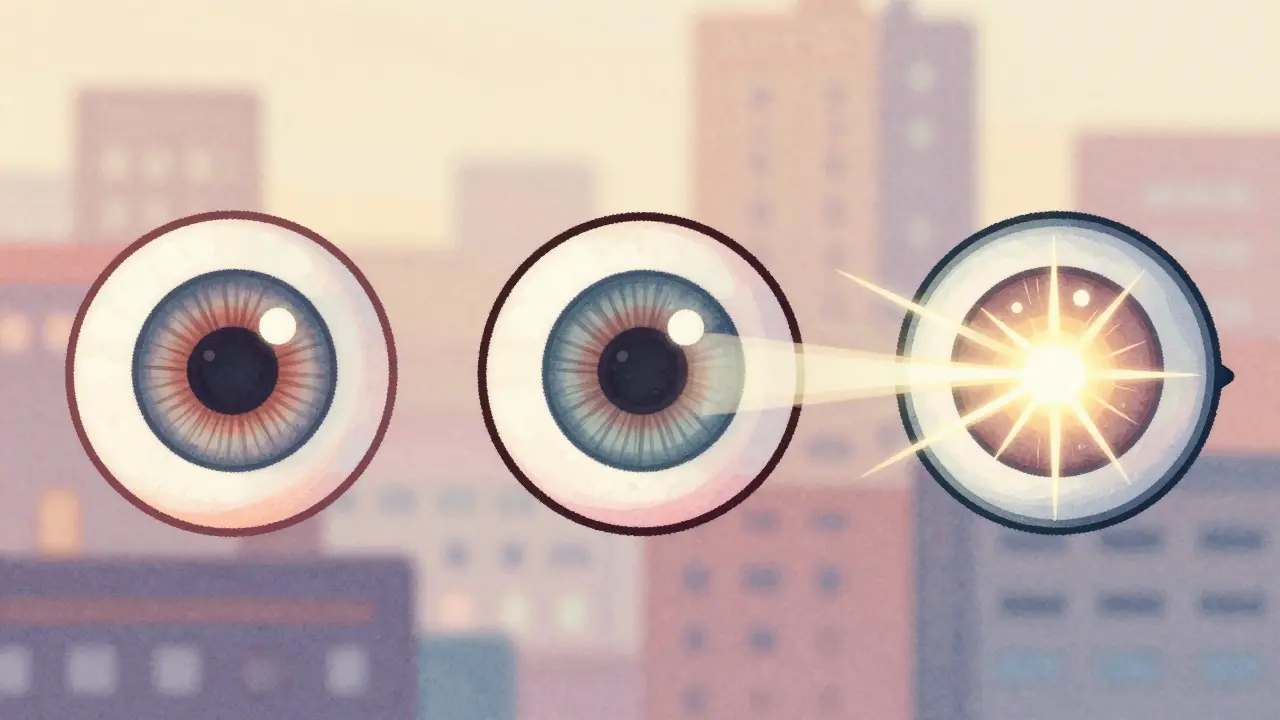

Blurred vision isn’t just annoying-it’s a sign your eye isn’t focusing light the way it should. This happens in refractive errors, where the shape of your eye stops light from landing perfectly on the retina. The three most common types are myopia (nearsightedness), hyperopia (farsightedness), and astigmatism. Together, they affect over half of adults aged 40 to 69, according to the UK Biobank study. If you’ve ever squinted to read a license plate or struggled to see up close without glasses, you’ve likely experienced one of these.
What Causes Myopia, Hyperopia, and Astigmatism?
Myopia happens when your eyeball is too long or your cornea curves too sharply. Light focuses in front of the retina instead of on it. That’s why distant objects look blurry. In adults, this usually means an axial length over 24mm or corneal curvature above 43 diopters. It often starts around age 10 and gets worse until your late teens or early 20s. East Asian populations see rates as high as 80-90% in young adults, while in the U.S. and Europe, it’s closer to 30-40%.
Hyperopia is the opposite. Your eye is too short-under 22mm-or your cornea is too flat (less than 40 diopters). Light focuses behind the retina, making close-up tasks like reading or using a phone hard. Many kids are born with mild hyperopia, but their eyes grow out of it. If it stays into adulthood, it can cause eye strain, headaches, and trouble with detail work.
Astigmatism is different. It’s not about length or curvature alone-it’s about shape. Instead of being round like a basketball, the cornea or lens is more like a football. This means light bends unevenly and hits the retina at multiple points. The result? Blurry or distorted vision at all distances. About 30-60% of people have some level of astigmatism, and it often shows up with myopia or hyperopia. People with uncorrected astigmatism report seeing halos around lights or feeling like they’re looking through water.
How Are These Conditions Corrected?
Correction is simple in theory: counter the eye’s error with the right lens. For myopia, you need a minus (-) lens that spreads out light before it enters the eye. For hyperopia, a plus (+) lens bends light inward to bring the focus forward. Astigmatism needs a cylinder lens with a specific axis angle to balance the uneven curvature.
Three main tools do this: glasses, contact lenses, and surgery.
Glasses are the most common fix. They’re safe, easy, and work immediately. Most people adjust in a few days, but complex astigmatism prescriptions can take up to three weeks. One user on Reddit said it took them three weeks to get used to a new cylinder axis at 175 degrees. Choosing frames with kids involved improves compliance-something children’s hospitals have known for years.
Contact lenses offer a wider field of view and no frames to fog up or slip. But they come with risks. About 3-4% of wearers develop microbial keratitis-an infection that can damage the cornea. Daily discomfort is also common; one user reported their contacts felt dry after eight hours. Soft toric lenses are designed for astigmatism, but they can rotate on the eye, causing temporary blurring until they settle.
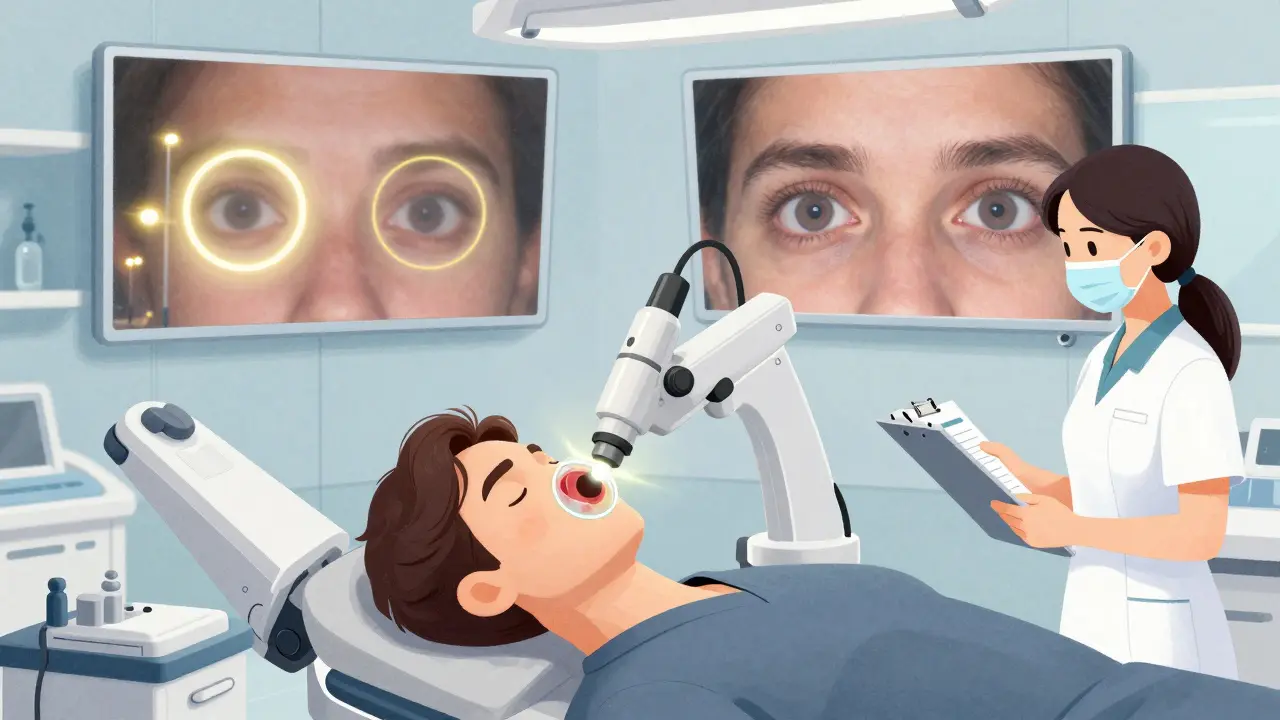
Refractive surgery removes the need for lenses entirely. LASIK, PRK, and SMILE are the top options. LASIK (approved by the FDA in 1995) reshapes the cornea with a laser. SMILE, a newer technique, uses a smaller incision and causes fewer dry eye issues-making it a favorite for people with sensitive eyes. Modern femtosecond lasers correct vision within 0.25 diopters of precision. Patient satisfaction scores on review platforms average 4.5 out of 5 for surgery, higher than glasses (4.2) or contacts (3.8).
Who Is Most Affected? And Why?
Myopia isn’t just genetic-it’s environmental. Kids who spend too much time indoors and too little in natural light are at higher risk. The National Eye Institute points to close-up work and lack of outdoor time as major contributors. That’s why myopia rates have exploded in urban areas with high academic pressure.
Hyperopia is more common in Native American populations, with prevalence as high as 25%. It also becomes more noticeable after age 40, as the lens stiffens-a condition called presbyopia. This isn’t the same as hyperopia, but it can make farsightedness worse.
Astigmatism affects nearly everyone to some degree. It’s not rare-it’s normal. But if it’s uncorrected, it leads to chronic eye strain, headaches, and trouble driving at night. One patient described it as “seeing double outlines on signs,” which disappeared only after their optometrist adjusted the cylinder axis.

Advanced Treatments and Emerging Options
For kids with progressive myopia, traditional glasses aren’t enough. Orthokeratology (Ortho-K) lenses worn overnight gently reshape the cornea, slowing myopia progression by 36-56%. Low-dose atropine eye drops (0.01%-0.05%) are another breakthrough-reducing progression by 50-80% over two years in clinical trials.
Wavefront-guided LASIK now maps each eye’s unique imperfections, not just the basic prescription. This is especially helpful for astigmatism cases that were once hard to correct. SMILE procedures are expected to grow 15% annually through 2028 because they’re gentler on tear production.
But even with these advances, prevention matters. The World Health Organization estimates 123.7 million people have moderate to severe vision loss from uncorrected refractive errors. That’s more than the population of the United States. By 2050, half the world could be myopic, according to the Brien Holden Vision Institute. That’s not just a health issue-it’s a global infrastructure challenge.
What to Expect After Correction
After getting glasses or contacts, most people notice improvement right away. But adjustment isn’t instant. Your brain needs time to relearn how to interpret the corrected image. That’s why some report dizziness or odd depth perception at first.
Surgery patients often say their vision feels “crisper” and “more natural.” But not everyone gets perfect results. About 20-40% of LASIK patients experience temporary dry eyes. Night vision problems-like glare or halos-are also common in the first few months.
High myopia (over -6.00 diopters) carries long-term risks. People with this level of nearsightedness have 5-10 times higher risk of retinal detachment or degeneration. Regular eye exams are non-negotiable here. Even if your vision is stable, the retina needs monitoring.
Choosing the Right Correction
There’s no one-size-fits-all. Here’s how to think about it:
- For kids and teens: Glasses are safest. Ortho-K or atropine drops can slow progression.
- For active adults: Contacts or surgery offer freedom. But if you’re in a dusty job or swim often, contacts may not be ideal.
- For astigmatism: Make sure your prescription includes cylinder and axis numbers. Undercorrection is a common cause of ongoing discomfort.
- For surgery: You need a stable prescription for at least 12 months, corneas thicker than 500 microns, and to be 18 or older.
Don’t ignore symptoms. Headaches after screen time, squinting to see the TV, or holding books farther away aren’t normal aging-they’re signs your eye needs attention.
Can refractive errors be cured?
Refractive errors can’t be permanently cured without surgery, but they can be fully corrected. Glasses, contacts, and procedures like LASIK restore clear vision by compensating for the eye’s shape. Surgery changes the cornea permanently, so you won’t need lenses anymore-but your eye’s structure still has the original error. Think of it like fixing a lens, not healing the eye.
Is astigmatism worse than myopia or hyperopia?
Not necessarily. Astigmatism is more complex because it affects both near and far vision at once, unlike myopia (distant blur) or hyperopia (near blur). But it’s not more dangerous. All three can be corrected effectively. The real issue is undercorrection-many people get prescriptions that don’t fully address the cylinder or axis, leading to ongoing strain and headaches.
Can children outgrow refractive errors?
Some kids outgrow mild hyperopia as their eyes grow. But myopia almost always worsens during childhood and adolescence. It typically stabilizes in the late teens. Astigmatism rarely changes much-it’s usually present from birth and stays stable. Early correction is key to prevent eye strain and support visual development.
Do contact lenses make refractive errors worse?
No. Contacts don’t make your vision worse. But poor hygiene can cause infections that damage the cornea. Also, wearing contacts too long or sleeping in them increases risk. The problem isn’t the lens-it’s how they’re used. Proper care and replacement schedules prevent complications.
Why does my vision get blurry after screen time?
Blurry vision after screens is often digital eye strain, not a worsening refractive error. But if you have uncorrected astigmatism or mild hyperopia, focusing on close objects for hours makes it worse. The 20-20-20 rule-every 20 minutes, look at something 20 feet away for 20 seconds-helps. If blurriness persists after rest, get your prescription checked.
Is LASIK safe for people with astigmatism?
Yes, and modern LASIK is especially good for astigmatism. Wavefront-guided systems map the irregular curvature and correct it precisely. Many patients with astigmatism report better results after LASIK than with glasses or contacts. But you need a thorough pre-op exam to ensure your cornea is thick enough and your prescription is stable.
How often should I update my glasses prescription?
Adults with stable vision should get checked every two years. Kids and teens with myopia may need updates every 6-12 months as their eyes grow. If your vision changes suddenly-like blurry vision, double images, or headaches-you shouldn’t wait. Don’t assume your old glasses still work.
What’s Next?
If you’re considering correction, start with a comprehensive eye exam. Don’t just get a vision screening at the pharmacy-ask for a refraction test that measures cylinder and axis for astigmatism. Talk to your eye doctor about your lifestyle. If you’re active, surgery might be worth exploring. If you’re a parent of a child with myopia, ask about Ortho-K or atropine drops. The goal isn’t just to see clearly-it’s to protect long-term eye health. With today’s options, you don’t have to live with blurry vision.



Aisling Maguire
27 Feb 2026 at 15:55I got my first glasses at 12 and thought they were the lamest thing ever. Fast forward 15 years and I’m basically a human eyeball with a nose now. My astigmatism was so bad I used to squint at street signs like I was trying to decode ancient hieroglyphs. The first time I put in my toric contacts? Felt like I’d been living in a fog and someone cracked open a window. Still hate putting them in though. 😅