

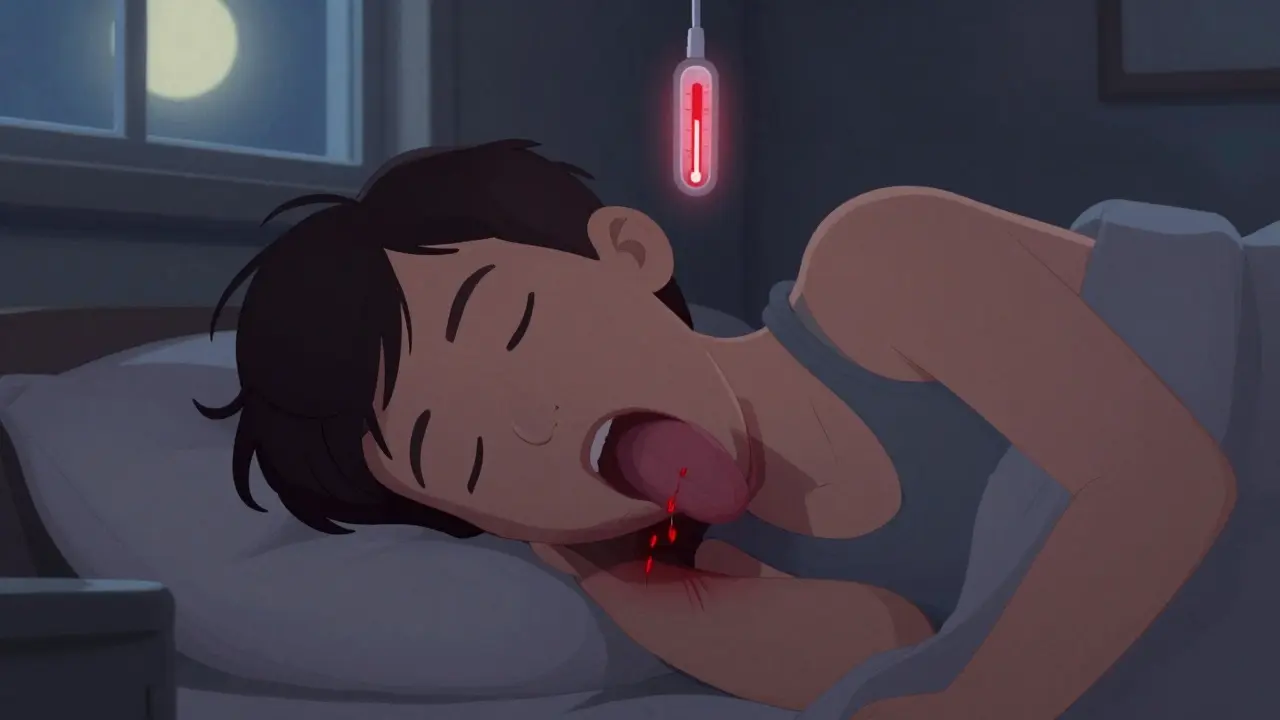

If you have sleep apnea, where you stop breathing briefly during sleep, your position might be making it worse. Sleeping on your back-called supine sleeping-is one of the biggest triggers for breathing problems. But switching to side sleeping can cut your apnea events in half, sometimes even more. This isn’t just a suggestion. It’s a proven, non-invasive treatment called positional therapy, and it works for a large group of people who don’t respond well to CPAP machines or don’t want to use them.
Why Sleeping on Your Back Makes Apnea Worse
When you lie flat on your back, gravity pulls your tongue and soft tissues in your throat backward. This narrows your airway by 30-40%, making it easier for it to collapse during sleep. The result? More breathing pauses, louder snoring, and deeper drops in oxygen levels. Studies show that for many people with obstructive sleep apnea (OSA), the number of breathing interruptions per hour can jump from 5-8 when sleeping on their side to over 30 when on their back. That’s the difference between mild and severe apnea.It’s not just about quantity-it’s about severity. Apneas that happen while you’re on your back tend to last longer, cause bigger drops in blood oxygen, and trigger more heart rate spikes and awakenings. One study found that supine sleeping increases the risk of heart strain and even stroke during sleep. For people with positional OSA (POSA), the problem is so clear that doctors define it by a simple rule: if your apnea-hypopnea index (AHI) is at least double when you’re on your back compared to your side, you’re a candidate for positional therapy.
How Side Sleeping Helps
Sleeping on your side-lateral positioning-keeps your airway open. Gravity works differently here. Your tongue stays forward, your throat muscles don’t collapse as easily, and airflow stays steady. The Sleep Foundation calls side sleeping the best position for OSA, and for good reason. People who switch from back to side often see their AHI drop from 25 to under 5. That’s not just improvement-it’s remission. Snoring often stops completely within seconds of rolling over.Side sleeping doesn’t just help with obstructive apnea. It can also ease central sleep apnea (CSA), though the effect is less dramatic. Researchers think this is because side sleeping changes lung pressure and how your brain sends breathing signals. But for most people, the biggest wins come with OSA.
What Is Positional Therapy?
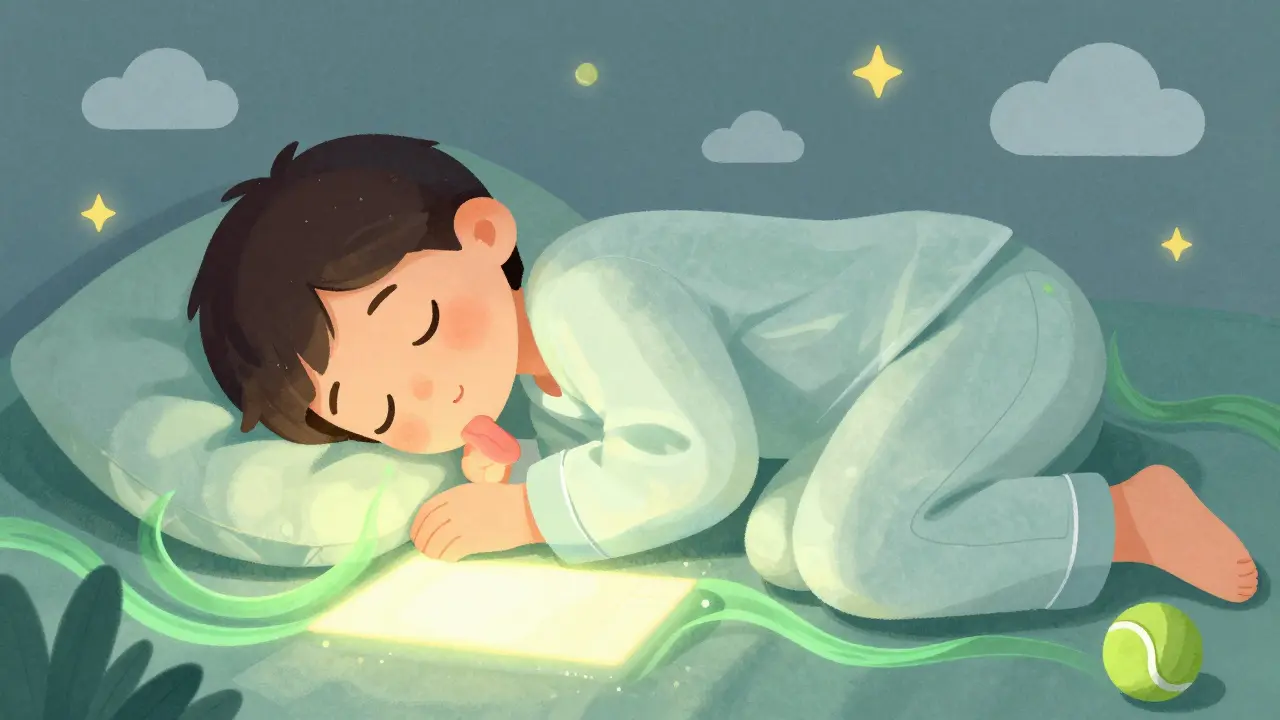
Positional therapy is any method that helps you avoid sleeping on your back. It’s not about willpower. It’s about physics and feedback. There are two main types: simple, low-cost methods and high-tech wearable devices.The classic DIY method is the tennis ball technique (TBT). You sew a tennis ball into the back of your pajamas or sleep shirt. If you roll onto your back, the ball digs into your spine-it’s uncomfortable enough to make you shift position. It’s cheap, easy, and surprisingly effective. A 2015 study found that TBT reduced supine sleeping time to zero for many users. But here’s the catch: nearly half of people quit within three months because the ball hurts, disrupts sleep, or just feels awkward.
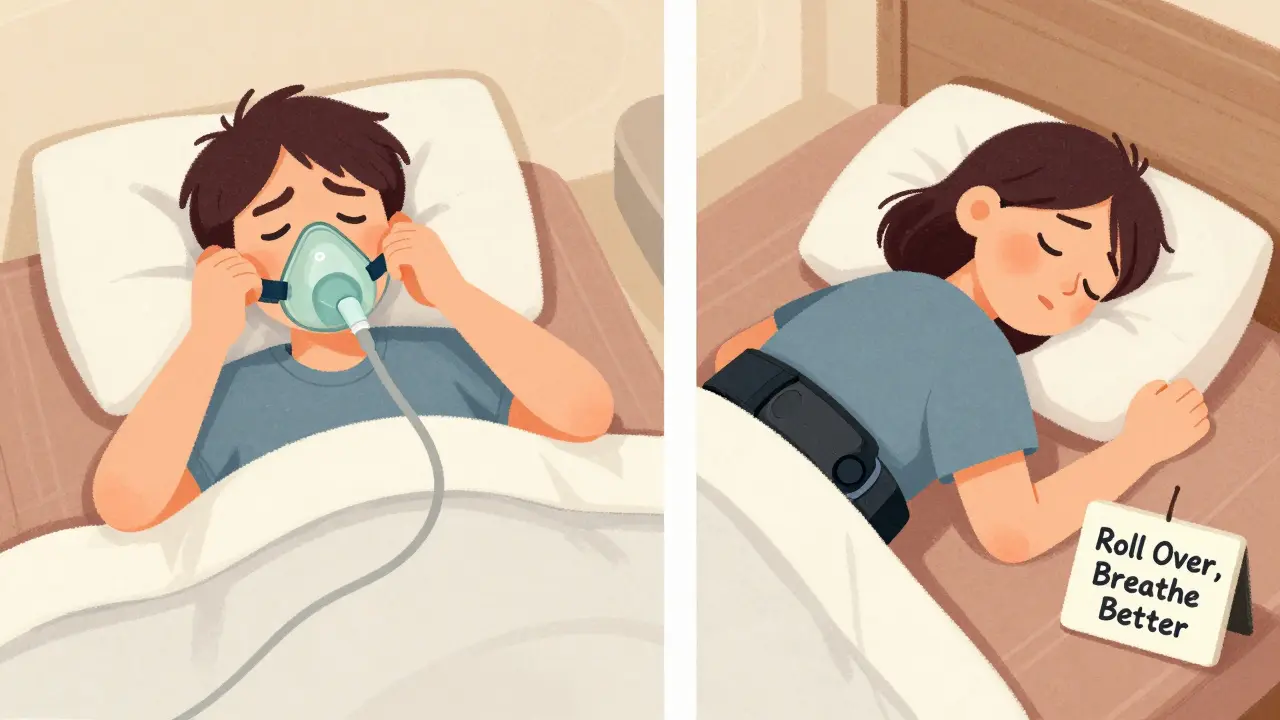
That’s where advanced devices come in. The sleep position trainer (SPT) is a wearable belt or vest that vibrates gently when you roll onto your back. It doesn’t wake you up-it nudges you. Devices like NightBalance and Smart Nora use this tech. They’re more expensive ($300-$500), but they’re far more comfortable. In the same 2015 study, SPT users had 30% better compliance than TBT users. They also reported better sleep quality, less daytime fatigue, and higher satisfaction scores on quality-of-life surveys.
Positional Therapy vs. CPAP
CPAP is still the gold standard. It works. But it’s hard to stick with. Studies show that only about 50-60% of people use CPAP consistently over time. Many quit because of mask discomfort, noise, or claustrophobia.Positional therapy doesn’t have those problems. People wear a lightweight belt or sleep in a regular shirt with a ball. It’s quiet. It’s unobtrusive. And adherence rates are 35-40% higher than CPAP. For someone with mild to moderate positional OSA, that’s a game-changer. The American Academy of Family Physicians says positional therapy should be a first-line option for these patients. You don’t need to jump straight to a machine that blows air into your nose. Try changing your position first.
That said, positional therapy isn’t a replacement for everyone. If your apnea is severe everywhere-whether you’re on your back or side-then CPAP or an oral appliance is still the better choice. Positional therapy only works if your problem is position-dependent.
Who Should Try It?
Not everyone with sleep apnea will benefit. You need to have positional OSA. How do you know? A sleep study must break down your AHI by position. If your supine AHI is at least twice your side AHI, you qualify. One study of nearly 700 patients found that lateral AHI (the number of events on your side) actually predicts daytime sleepiness better than supine AHI. That means even if your back sleeping is bad, if your side sleeping is still high, positional therapy alone won’t fix everything.Doctors usually recommend positional therapy for people with mild to moderate OSA (AHI 5-30) who have clear positional dependence. It’s especially useful for those who tried CPAP and quit, or for people who don’t want to use one. It’s also a great option for younger, healthier patients who don’t have other serious medical conditions.
Real-World Results
People who stick with positional therapy report life-changing results. Bed partners notice snoring stops. People wake up feeling rested. Headaches and brain fog fade. One user from Leeds told a sleep clinic, “I didn’t realize how tired I was until I stopped sleeping on my back. I started playing with my kids again.”Success isn’t instant. It takes two weeks to train your body. Some people use pillows or wedge supports to help stay on their side. Elevating the head of the bed by 6-8 inches can also help-this keeps your airway open and reduces reflux, which often worsens apnea.
Market data shows adoption is growing fast. Since 2020, sales of positional therapy devices have increased by 25% each year. That’s because people are realizing: you don’t need a machine that makes noise to breathe better. Sometimes, you just need to roll over.
What to Try First
If you suspect you have positional OSA, start simple:- Get a sleep study that includes positional analysis. Don’t accept a report that doesn’t break down events by position.
- Try the tennis ball technique for 1-2 weeks. If it works, stick with it. If it hurts too much, stop.
- Use a body pillow or wedge pillow to prop yourself on your side.
- Elevate your head slightly-use a pillow under your mattress, not just under your head.
- If you’re still struggling after a month, consider a sleep position trainer. Look for FDA-cleared devices like NightBalance or Smart Nora.
There’s no shame in starting simple. Many people who end up using high-tech devices started with a tennis ball and a pillow. The goal isn’t to buy the fanciest gadget. It’s to breathe better at night.




Andrew Mamone
21 Mar 2026 at 06:27Just tried the tennis ball trick last week 🤯
Woke up at 3 a.m. with a bruise on my spine but honestly? No snoring. No gasping. No more 5 a.m. headaches.
My wife hasn’t slept this well in years. We’re both shocked.
It’s not glamorous, but sometimes the dumbest solutions are the ones that work.
Still using it. No regrets. 🙌