


What CPAP and BiPAP Actually Do
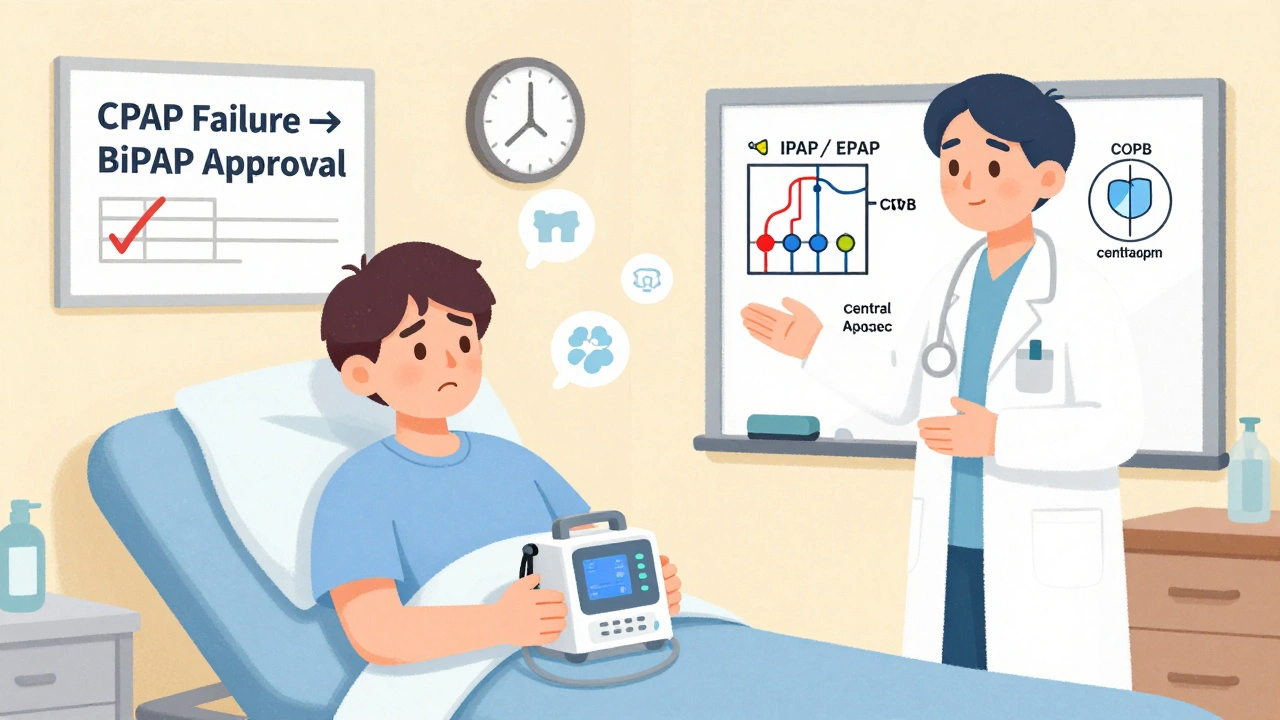
Both CPAP and BiPAP machines help you breathe better while you sleep. They push air through a mask to keep your airway open, stopping snoring and breathing pauses. But they don’t work the same way. CPAP delivers one steady pressure all night - whether you’re inhaling or exhaling. BiPAP gives you two different pressures: a higher one when you breathe in (IPAP), and a lower one when you breathe out (EPAP). This makes exhaling easier, especially if you need high pressure to keep your airway open.
How They’re Used in Real Life
Most people with obstructive sleep apnea (OSA) start with CPAP. About 85% to 90% of OSA patients do fine with it. If you’re diagnosed with mild to moderate OSA, your doctor will almost always recommend CPAP first. It’s simpler, cheaper, and just as effective for most people. A 2021 Cochrane review of nearly 2,000 patients found no big difference in sleep quality or how often people used the machine between CPAP and BiPAP for standard OSA.
BiPAP isn’t for everyone. It’s reserved for specific cases where CPAP doesn’t work well. For example, if you need high pressure - above 15 cm H₂O - exhaling against constant air can feel like breathing through a straw. BiPAP’s lower exhale pressure makes it much easier. People with COPD, obesity hypoventilation syndrome, or central sleep apnea also often need BiPAP. These conditions involve weak breathing muscles or poor carbon dioxide control, and BiPAP’s backup breath feature can help if you stop breathing on your own.
Pressure Settings and How They’re Set
CPAP pressure is set between 4 and 25 cm H₂O. Most people need between 8 and 12. BiPAP has two settings: IPAP (inhalation) and EPAP (exhalation). IPAP usually ranges from 8 to 30 cm H₂O, and EPAP from 4 to 25. The difference between them - called pressure support - should be at least 3 cm H₂O. For example, a common BiPAP setting might be IPAP 14 and EPAP 8.
Both devices need a sleep study to set the right pressure. For CPAP, one night of testing is usually enough. BiPAP often takes longer - sometimes 1.5 to 2 nights - because doctors have to find the right balance between IPAP and EPAP. Medicare and most insurers require proof you tried CPAP first before approving BiPAP. You have to show you couldn’t tolerate at least 15 cm H₂O for four hours a night over 30 days.

Cost and Insurance Coverage
CPAP machines cost between $500 and $1,200. A basic ResMed AirSense 10 runs around $899. BiPAP machines are pricier - $800 to $1,800. The Philips DreamStation BiPAP Auto sells for about $1,499. The bigger cost isn’t the machine, though. It’s the follow-up care. BiPAP requires more setup, training, and adjustments. That means more visits to your sleep clinic or respiratory therapist.
Insurance coverage reflects this. Medicare covers 80% of CPAP costs. For BiPAP, they require documented CPAP failure. Private insurers often follow the same rule. If you’re prescribed BiPAP without trying CPAP first, you might pay out of pocket. Some patients report being told they “need” BiPAP when CPAP would’ve worked - a practice that costs the U.S. healthcare system an estimated $420 million a year, according to a 2023 Health Affairs study.
Who Benefits Most From BiPAP?
BiPAP shines in four main situations:
- High-pressure CPAP users: If your CPAP pressure is 15 cm H₂O or higher and you can’t tolerate it, BiPAP can make breathing feel natural again. One Reddit user wrote, “BiPAP at 14/8 felt like breathing normally compared to choking on CPAP at 14.”
- COPD with sleep apnea: If you have both chronic lung disease and OSA, BiPAP helps you exhale better and clears out trapped carbon dioxide.
- Central sleep apnea: This isn’t caused by blocked airways - your brain just forgets to tell your lungs to breathe. BiPAP’s timed backup breaths kick in if you stop breathing for too long.
- Obesity hypoventilation syndrome: People with severe obesity (BMI ≥30) who have high carbon dioxide levels during the day need the extra support BiPAP provides.
For pure obstructive sleep apnea without these extra conditions, BiPAP doesn’t offer better results. A 2023 Chest Journal review of 22 studies found no significant advantage for simple OSA.
Real User Experiences
Surveys show CPAP users are slightly more satisfied - 78% vs. 72% for BiPAP. But that’s misleading. CPAP users are mostly people with simple OSA who do well with it. BiPAP users are often those who struggled with CPAP and switched because they had no other choice. Among this group, satisfaction jumps. A 2023 survey on CPAP.com found BiPAP users used their machine ≥6 hours per night at a higher rate (68%) than CPAP users (62%), likely because they finally found relief.
But BiPAP isn’t easy. About 34% of BiPAP users report trouble with settings and modes. Some machines don’t sync well with breathing, causing “cycling issues” - sudden pressure changes that feel jarring. CPAP users rarely have this problem. One Sleep Review Magazine survey found 18% of CPAP users struggled with setup, compared to 34% of BiPAP users. Simplicity matters. About 71% of CPAP users rated ease of use as excellent. Only 58% of BiPAP users did.
Learning Curve and Support
Most people need 2 to 4 weeks to get used to CPAP. BiPAP takes longer - 3 to 6 weeks - because there’s more to learn. You’re not just adjusting to air pressure. You’re learning how the machine switches between two pressures, what the backup breath feature does, and how to interpret error codes.
ResMed data shows 92% of CPAP users solve problems using online guides or customer service. Only 78% of BiPAP users can do the same. That’s why the American Thoracic Society recommends working with a respiratory therapist for BiPAP setup. CPAP often just needs a mask fitting and a quick tutorial. BiPAP needs a full training session. If you’re not comfortable with technology or have trouble remembering settings, BiPAP might add stress instead of relief.
Market Trends and What’s Next
CPAP still dominates the market - 68% of all PAP devices sold in 2022. But BiPAP is growing faster. The global market for BiPAP is expected to rise at 9.2% per year through 2030, compared to 6.8% for CPAP. Why? Aging populations, rising obesity rates, and more diagnosis of complex sleep disorders like COPD-OSA overlap. New machines are getting smarter. ResMed’s AirCurve 10 VAuto and Philips’ DreamStation 3 now use AI to adjust pressure in real time based on your breathing. Some even track oxygen levels without a separate sensor.
But the big question remains: Are we overprescribing BiPAP? Experts like Dr. David White, former president of the American Academy of Sleep Medicine, say yes. “BiPAP should be reserved for specific indications,” he said in 2022. “For most OSA patients, it’s unnecessary complexity.”
Choosing the Right One for You
Here’s how to decide:
- Get a sleep study. Don’t guess. Your doctor needs to know if you have obstructive, central, or mixed apnea - and how severe it is.
- Try CPAP first. Unless you have COPD, central apnea, or obesity hypoventilation, CPAP is your best starting point.
- Track your usage. If you’re using CPAP less than 4 hours a night for 30 days, talk to your provider. Maybe you need a different mask, humidifier, or pressure setting - not a new machine.
- Only consider BiPAP if: You need high pressure (≥15 cm H₂O), you have another lung condition, or your brain isn’t signaling your lungs to breathe properly.
- Ask about insurance rules. Make sure your plan will cover BiPAP. You may need to prove CPAP didn’t work.
There’s no “better” device. Only the right one for your body and condition. For most people, CPAP is simple, effective, and enough. For others, BiPAP is the only thing that lets them sleep without gasping for air. The goal isn’t to pick the fanciest machine. It’s to find the one that lets you breathe - and sleep - without struggle.



John Webber
3 Dec 2025 at 05:15cpap is fine for most people but biPAP is just a money grab by the med industry. they want you to buy the fancy machine so they can charge more. i had a friend who got biPAP because his doctor said so, but he could’ve used cpap just fine. now he’s stuck with a $1500 machine that beeps at him all night. smh.